





As airlines chase efficiency on short-haul routes, turboprop aircraft—led by the ATR family—are outperforming regional jets where it matters most: economics, flexibility and real-world operating efficiency

For decades, turboprop aircraft have occupied a paradoxical position in commercial aviation. Often overshadowed by the speed, altitude and perceived prestige of regional jets, turboprops have nonetheless remained the backbone of short-haul regional connectivity across large parts of the world. In markets where sector lengths are short, infrastructure is constrained and passenger demand fluctuates sharply by time of day and season, turboprops—particularly the ATR 42 and ATR 72—continue to deliver an economic and operational logic that jets frequently struggle to match.
Despite repeated predictions of their decline, turboprops have endured because they address the realities of regional aviation more accurately than many jet-powered alternatives. As airlines globally reassess cost structures, sustainability targets and network efficiency amid rising fuel prices and competitive pressures, the debate over turboprops versus regional jets has resurfaced with renewed relevance. A closer examination of operating realities shows that turboprops are not legacy solutions, but purpose-built aircraft optimised for short-haul flying.
UNDERSTANDING THE TURBOPROP ADVANTAGE
At the heart of the turboprop’s strength lies its propulsion architecture. Unlike regional jets, which rely on high-velocity exhaust thrust to generate forward momentum, turboprops produce the majority of their thrust through large, slow-turning propellers driven by turbine engines. This fundamental difference gives turboprops a clear advantage at lower speeds and altitudes.
Short-haul routes rarely allow aircraft to operate in their most aerodynamically efficient regime. On sectors typically under 500 kilometres, aircraft spend a disproportionate amount of time climbing after take-off and descending toward landing, with relatively little time at cruise. Regional jets are optimised to deliver their best fuel efficiency at higher altitudes over longer cruise segments. On short routes, they seldom reach or remain at those optimal conditions.
Turboprops, by contrast, are designed to operate efficiently at lower altitudes and speeds. This allows them to avoid the efficiency penalty jets incur during repeated climb-and-descent cycles. In practical airline operations, this translates into significantly lower fuel burn per trip and, crucially, lower fuel burn per seat.
ATR: THE BENCHMARK IN REGIONAL TURBOPROPS
The global turboprop market is overwhelmingly dominated by ATR, whose ATR 42 and ATR 72 families have become the default choice for regional airlines worldwide. With seating capacities ranging from around 40 to nearly 80 passengers, these aircraft are engineered specifically for high-frequency, short-haul operations where efficiency and reliability outweigh outright speed.
“FLY91 plans to have a total of 76 ATRs. India is a Turboprop country and a minimum of 250 aircraft are required for India.”
—Manoj Chacko, Founder, Managing Director and CEO of FLY91
Powered by Pratt & Whitney Canada PW100-series engines, ATR aircraft combine fuel efficiency with robust performance across a wide range of operating environments. From tropical heat and humidity to high-altitude airports and cold-weather operations, ATRs have demonstrated consistent reliability.
What truly distinguishes ATR aircraft is not headline performance metrics, but operational consistency. Whether operating from major hubs or infrastructure-limited regional strips, ATRs have built a reputation as dependable workhorses capable of sustaining demanding utilisation patterns day after day. This reliability is particularly valuable for regional airlines, where aircraft downtime directly impacts network integrity and profitability.
FUEL EFFICIENCY: THE DEFINING METRIC
Fuel remains the single largest variable cost for airlines, and it is in this area that turboprops establish their strongest and most enduring advantage. On short-haul routes, turboprops typically burn between 30 and 50 per cent less fuel than comparable regional jets, depending on sector length, payload and operating conditions.
This difference is far from marginal. It fundamentally reshapes route economics. Regional jets achieve their best efficiency only when cruising at altitude for sustained periods, something short routes rarely permit. As a result, jets often consume disproportionately more fuel relative to the distance flown.
Turboprops, operating efficiently from take-off to landing, avoid this inefficiency entirely. For airlines operating dense shorthaul networks with multiple daily frequencies, the cumulative fuel savings are substantial. Lower fuel burn translates directly into lower trip costs, improved margins and greater resilience against fuel price volatility—an increasingly important consideration in today’s unpredictable energy markets.
RUNWAY FLEXIBILITY AND NETWORK REACH
Another decisive advantage of turboprops is their ability to operate from shorter and less-developed runways. Aircraft such as the ATR 72 can safely operate from runways that would be restrictive or commercially impractical for regional jets, particularly in hot-and-high conditions where jet performance degrades rapidly.
This capability dramatically expands network possibilities. Turboprops enable airlines to serve secondary cities, regional hubs and remote locations without the need for expensive runway extensions or infrastructure upgrades. In emerging aviation markets, where many airports have limited facilities, this flexibility is often the difference between a viable route and one that cannot be operated at all.
Even in mature markets, congestion at major hubs has increased interest in secondary airports. Turboprops provide airlines with the flexibility to bypass congested infrastructure while maintaining connectivity, something jets struggle to do economically.
MATCHING CAPACITY TO DEMAND
One of the most persistent challenges in regional aviation is capacity mismatch. Deploying a regional jet with 90 or more seats on a route that consistently supports 50 to 70 passengers leads to weak load factors and eroded profitability. Overcapacity is a silent killer in regional networks.
Turboprops enable airlines to serve secondary cities, regional hubs and remote locations. In markets, where many airports have limited facilities, this flexibility is often the difference between a viable route and one that cannot be operated at all.
Turboprops, with their smaller seating capacities, allow airlines to align supply more closely with actual demand. This capacity discipline improves load factors and reduces the financial risk associated with demand volatility. Importantly, it also enables airlines to offer higher frequency schedules rather than fewer, larger aircraft rotations.
For business travellers and regional commuters, frequency often matters more than speed. A turboprop offering multiple daily departures can be more attractive than a faster jet operating less frequently. From a revenue management perspective, this flexibility enhances network strength and customer loyalty.
ECONOMICS OF OPERATIONS BEYOND FUEL
The economic case for turboprops extends well beyond fuel savings. Maintenance costs are typically lower due to simpler propulsion systems and long-established maintenance regimes. The engines, gearboxes and airframes of modern turboprops are designed for durability and ease of maintenance, particularly in challenging environments.
Acquisition and leasing costs are also generally lower than those of regional jets, reducing capital exposure for airlines. This is especially important for regional operators and startup carriers, where capital efficiency is critical.
Shorter turnaround times further enhance turboprop economics. Faster ground handling allows aircraft to complete more sectors per day, increasing utilisation and spreading fixed costs over a greater number of flights. Over time, these factors combine to deliver a significantly lower cost per available seat kilometre on short-haul routes.
A SUSTAINABLE CASE FOR THE FUTURE
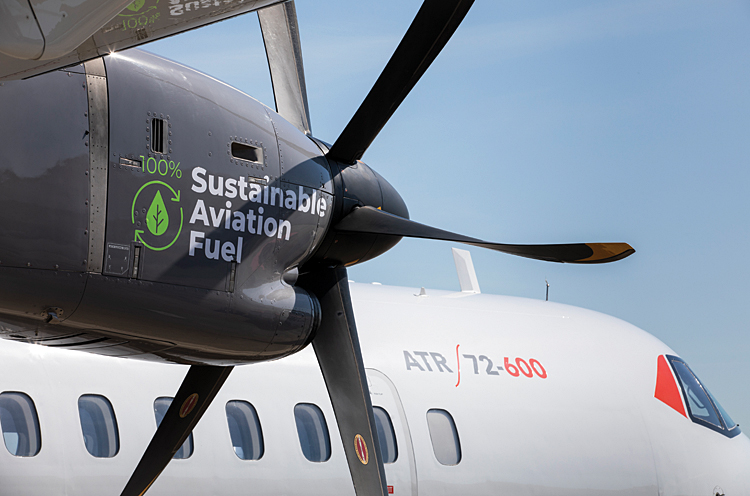
As aviation faces mounting pressure to reduce emissions, turboprops present a structurally lower carbon footprint per seat on short routes. Lower fuel burn directly translates into lower CO2 emissions, making turboprops a practical tool for airlines pursuing sustainability goals without sacrificing connectivity.
For short-haul routes, replacing jet operations with turboprops can deliver immediate emissions reductions without waiting for future propulsion technologies. This positions turboprops as a pragmatic, near-term solution in an industry seeking realistic pathways to decarbonisation.
CONCLUSION: PURPOSE-BUILT FOR SHORT HAUL
In an industry often drawn to speed, scale and branding, turboprops represent a disciplined, purpose-built solution for shorthaul aviation. Aircraft such as the ATR 42 and ATR 72 demonstrate that efficiency, flexibility and economic realism matter more than headline performance.
For airlines focused on profitability, sustainability and regional connectivity, turboprops are not a compromise. They remain, in many cases, the most rational and effective aircraft for short-haul operations—quietly proving that in aviation, the right tool still matters more than the fastest one.