




Achieving net-zero emissions by 2050 is driving a profound transformation across the aviation sector. The industry is reshaping its entire ecosystem to ensure the future of flight is truly sustainable.
For more than a century, aviation has been an industry defined by movement. It has made distant places accessible, connected economies and transformed the way people and goods move around the world. But as the industry enters another period of technological change, one question has become impossible to avoid: how can aviation continue to grow while dramatically reducing its environmental footprint? The answer is unlikely to come from a single technology.
The aviation industry’s commitment to achieving net-zero carbon emissions by 2050 has set in motion one of the most significant transformations in its history. Aircraft manufacturers are developing new airframes and propulsion systems, engine makers are pursuing entirely new architectures, airlines are renewing fleets and investing in alternative fuels, while airports are preparing for infrastructure that barely existed on the drawing board a decade ago. At the centre of this transition, however, sits Sustainable Aviation Fuel, or SAF.
SAF is not the only solution to aviation’s sustainability challenge. But it may be the most important solution available to the industry today because, unlike hydrogen or fully electric propulsion, it offers a pathway to reduce the carbon intensity of aviation without requiring the immediate replacement of the global aircraft fleet. That makes SAF less a destination than a bridge—and the strength of that bridge could determine how quickly aviation reaches its longer-term ambitions.
SAF: THE IMMEDIATE OPPORTUNITY
The appeal of SAF is straightforward. Modern aviation depends heavily on liquid hydrocarbon fuels because aircraft require enormous amounts of energy while carrying that energy over long distances. Batteries remain poorly suited to powering large commercial aircraft because of their weight, while hydrogen will require significant changes to aircraft design and airport infrastructure.
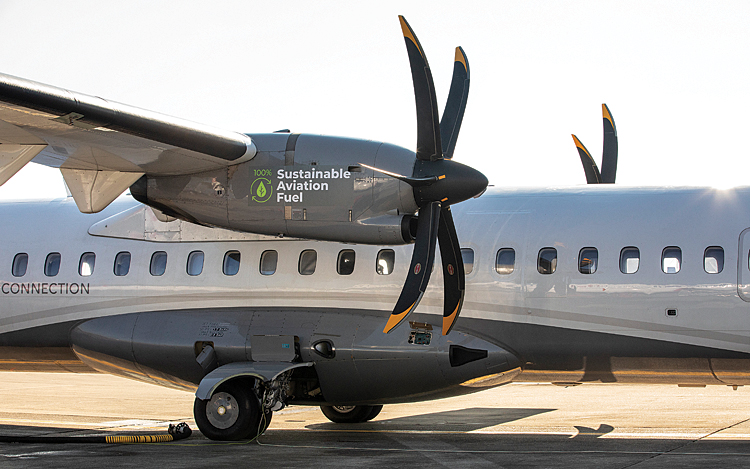
SAF works within a much more familiar framework. Produced from renewable and waste-based feedstocks through approved production pathways, SAF can be blended with conventional jet fuel and used in existing aircraft and engines within current certification limits. The industry’s objective is to move progressively toward aircraft capable of operating on 100 per cent SAF.
Airbus and Boeing have both committed to achieving 100 per cent SAF capability for their commercial aircraft by 2030, while engine manufacturers are also conducting extensive testing and certification work.
This compatibility gives SAF a critical advantage. An aircraft entering service today can remain operational for decades. Waiting for an entirely new propulsion technology to replace the existing fleet would therefore leave the industry with a considerable emissions problem in the interim. SAF, by contrast, can begin working with the fleet that already exists.
But technological compatibility is only half the challenge. The bigger question is supply. SAF remains significantly more expensive than conventional jet fuel, with estimates putting its cost at roughly two to four times that of conventional fuel. That price difference makes large-scale adoption difficult without investment, policy support and mechanisms that create confidence for fuel producers. Airlines are consequently becoming more than fuel purchasers. They are increasingly becoming market makers.
Long-term offtake agreements allow airlines to commit to purchasing SAF in the future, giving producers greater certainty when making expensive investments in new production facilities. Airline-backed funds and partnerships are also being used to support emerging SAF technologies and production companies.
United Airlines, for example, has positioned SAF and carboncapture investment at the centre of its longer-term decarbonisation strategy. United CEO Scott Kirby has been particularly direct about the role SAF must play, saying: “The only way to decarbonise aviation really is SAF.” The statement is striking in its simplicity, but the challenge behind it is enormous. The industry cannot decarbonise through airline commitments alone. It needs an industrial-scale supply chain capable of producing alternative fuels in quantities measured not in demonstration projects, but in millions of tonnes.
That is why airline investment matters. It is not simply about purchasing a greener product; it is about helping create the market in which that product can exist at scale. Regulation will play a major role as well. Initiatives such as ReFuelEU Aviation are moving SAF from the realm of voluntary corporate commitments toward legally mandated blending requirements. That changes the equation for airlines and fuel suppliers alike. Sustainability gradually stops being an optional premium and becomes part of the industry’s basic cost structure.
The challenge is scale. SAF must move from an emerging alternative into a globally significant fuel industry. That will require investment across the entire supply chain—from feedstocks and production technology to transportation, airport storage and distribution. It will also require careful attention to the sustainability of the feedstocks themselves. A fuel cannot simply be labelled sustainable; its full lifecycle environmental impact has to justify the claim.
The aviation industry therefore finds itself in an unusual position. The technology for using SAF is progressing faster than the infrastructure required to produce enough of it. And that gap is precisely where the industry’s other sustainability efforts become important.
MAKING EVERY AIRCRAFT MORE EFFICIENT
Even in a future dominated by SAF, efficiency will remain essential. The cleanest fuel is still more valuable when an aircraft requires less of it.
Aircraft manufacturers have therefore continued to pursue aerodynamic improvements, lighter structures, better systems and more efficient propulsion. The latest generation of narrowbody aircraft can deliver fuel-burn improvements of approximately 15–20 per cent compared with aircraft that are around 15 years old. Fleet renewal consequently represents one of the most immediate sustainability measures available to airlines.
Replacing an older aircraft with a modern one does not require waiting for hydrogen propulsion, an entirely new airport infrastructure or a breakthrough in battery technology. It is a technology already available at commercial scale.
At the same time, manufacturers are looking further ahead. Airbus is pursuing more efficient next-generation aircraft alongside its hydrogen research, while Embraer’s Energia programme is examining hybrid-electric and hydrogen fuel-cell concepts for smaller regional aircraft.
Embraer CEO Francisco Gomes Neto has framed the wider challenge in similarly direct terms: “At Embraer, we recognise the urgency of the climate crisis and we are fully committed to a more sustainable future.” This broader commitment underpins the company’s work across hybrid-electric propulsion, hydrogen and other alternative-energy pathways.
The underlying philosophy is that sustainability in aviation will not arrive as one revolutionary aircraft that suddenly replaces everything flying today. It is more likely to emerge as a succession of technological improvements, each expanding what is commercially and operationally possible.
RETHINKING THE JET ENGINE
Engine manufacturers are pursuing some of the most consequential of those improvements. The biggest gains, however, may eventually come from changing the architecture of the engine itself. For decades, the commercial aviation industry has relied on increasingly refined versions of the turbofan. That approach has delivered remarkable improvements, but manufacturers now believe the next generation of efficiency will require more fundamental changes.
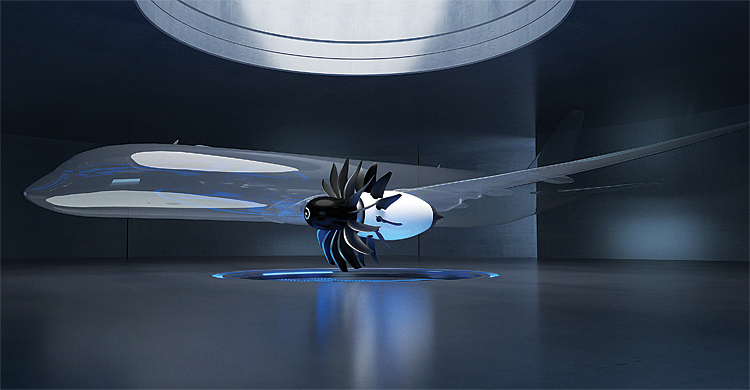
CFM International’s RISE programme is one of the clearest examples. The programme is centred on an open-fan architecture designed to achieve at least a 20 per cent improvement in fuel consumption and CO2 emissions compared with today’s most efficient commercial engines. Rather than enclosing the fan within a conventional nacelle, the design uses large open, counter-rotating blades to increase propulsive efficiency.
The urgency behind that approach has also been acknowledged by CFM’s leadership. Gaël Méheust, President and CEO of CFM International, said: “The industry can’t reach its net zero ambition by 2050 with status quo incremental improvements in fuel efficiency.”
It is a useful distinction. The industry’s sustainability challenge is no longer simply about making today’s engines marginally better; it is about developing technologies capable of changing the efficiency equation altogether.
GE Aerospace and Safran are pursuing the RISE programme as part of a wider effort to develop propulsion technologies capable of delivering a substantial step forward in efficiency. The programme also incorporates hybrid-electric technologies and research into alternative fuels, creating a propulsion platform designed around the broader transition rather than one isolated technological solution. GE Aerospace CEO H. Lawrence Culp Jr. has described the broader direction of the company in similarly forward-looking terms: “The future of flight is being shaped today, and GE Aerospace is proud to be at the forefront.”
The significance of these developments extends beyond fuel savings. If a future aircraft consumes substantially less fuel, every litre of SAF effectively goes further. The combination of efficient aircraft and lower-carbon fuel could therefore deliver a much greater environmental benefit than either approach in isolation.
HYDROGEN: THE LONGER-TERM BET
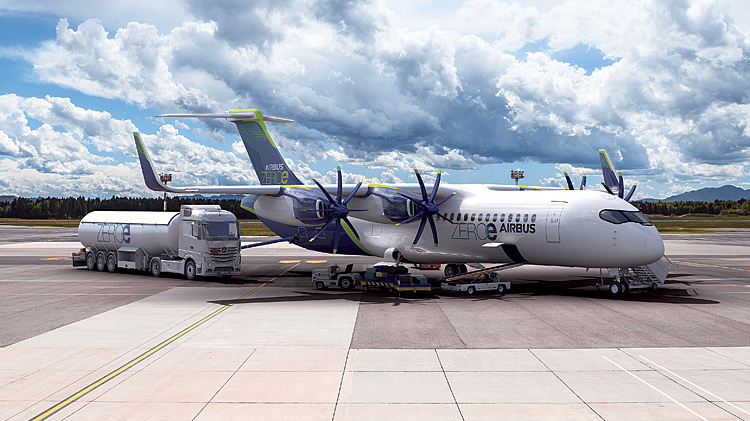
If SAF represents the bridge, hydrogen represents one possible longer-term destination. Hydrogen-powered aircraft have the potential to eliminate direct CO2 emissions during flight, particularly when hydrogen is produced using renewable energy. Airbus’s ZEROe programme is exploring hydrogen fuel-cell propulsion alongside direct hydrogen combustion.
Yet hydrogen demonstrates why aviation’s sustainability challenge extends far beyond aircraft design. Liquid hydrogen must be stored at approximately -253°C. Its storage requirements are fundamentally different from those of conventional jet fuel, and the fuel occupies considerably more volume. Airports would therefore require new storage facilities, transportation systems, safety zones and refuelling infrastructure.
Airbus CEO Guillaume Faury made this interdependence clear when discussing the future of hydrogen aviation: “This challenge is not only about an airplane. It is about having the right fuels— hydrogen at the right time, the right place, the right quantity, and the right price.” That is perhaps the defining characteristic of aviation’s sustainability transition: no single company can deliver it alone.
THE AIRPORT BECOMES PART OF THE SOLUTION
For decades, the airport has largely been treated as the interface between the aircraft and the passenger. In a more sustainable aviation system, it becomes something considerably more important. SAF requires production, transportation, storage and distribution systems capable of serving airports reliably. Hydrogen will require an entirely new infrastructure layer. Electric aircraft, if they eventually become commercially viable for larger segments of aviation, would require high-capacity charging infrastructure.
Airbus is already working with airports and energy companies on hydrogen infrastructure concepts, including partnerships in Europe, Norway and the Asia-Pacific region. These initiatives are examining how hydrogen can be produced, transported and ultimately supplied to aircraft.
This represents a shift in thinking. The sustainable aircraft of the future cannot simply arrive at an airport and expect the airport to adapt around it. Aircraft technology, energy infrastructure and airport design will have to evolve together.
SUSTAINABILITY ON THE GROUND
The environmental footprint of aviation also extends beyond the flight itself. Manufacturers are increasingly examining their own factories, supply chains and production processes. Airbus has established emissions-reduction targets for its own operations, Boeing is investing in more efficient facilities, and Embraer has set targets around renewable electricity and operational carbon neutrality.
Engine manufacturers are pursuing similar goals. Pratt & Whitney’s parent company, RTX, has invested in environmental projects focused on areas such as factory waste and water consumption, while also exploring greater recyclability of future engine products. RTX CEO Christopher Calio has likewise spoken about reducing water usage and scrap in manufacturing, reinforcing the idea that the sustainability challenge extends beyond what happens in the air.
The idea is increasingly moving beyond simply making an aircraft that consumes less fuel. It is about reducing the environmental impact of the entire lifecycle—from raw materials and manufacturing to maintenance, operation and eventual retirement. That introduces the concept of a more circular aviation industry, where components are repaired, reused and recycled wherever technically and economically practical.
There is also a remarkably straightforward sustainability measure already available to airlines: replace older aircraft. The latest generations of narrowbody aircraft can deliver fuel-burn reductions of roughly 15–20 per cent compared with aircraft around 15 years old. Fleet renewal therefore offers an immediate reduction in fuel consumption while the industry waits for more radical technologies to mature.
It may lack the glamour of hydrogen aircraft or open-fan engines, but replacing an inefficient aircraft with a modern one is one of the most practical decarbonisation tools available today.
AN INDUSTRY-WIDE TRANSFORMATION
What makes aviation’s sustainability challenge unusual is the sheer number of parties that must move together.
Aircraft manufacturers can develop hydrogen aircraft, but airports must build hydrogen infrastructure. Engine manufacturers can certify engines for 100 per cent SAF, but fuel producers must manufacture it at scale. Airlines can sign offtake agreements, but governments must establish policy frameworks that make investment viable. Corporate travellers can pay a green premium, but the underlying supply chain must have enough capacity to deliver meaningful emissions reductions.
Faury perhaps puts this interdependence most clearly. The transition is not simply about designing an aircraft; it requires the right energy ecosystem around it. That applies to hydrogen, but the principle is equally relevant to SAF. A technologically compatible fuel is of little use if it cannot be produced, transported and delivered at the scale aviation requires.
Safran is pursuing the same broader approach. Safran CEO Olivier Andriès has described decarbonisation as a strategic priority for the company, saying: “I welcome this agreement, which is fully in line with Safran’s strategic priority to decarbonize aviation.” The agreement he was referring to involved Safran and TotalEnergies working together on aviation decarbonisation, including sustainable fuels and more efficient propulsion technologies.
The target of 2050 remains ambitious. It may even take longer than currently anticipated. But ambition is necessary precisely because aviation cannot afford to wait until every technological answer is perfect. Faury has acknowledged the possibility that achieving net zero could take longer than the industry’s current target, while maintaining that aviation should not shy away from the ambition of reaching it. “Maybe it’s going to take a bit more time, but let’s not be shy in the ambition.”
The path ahead will not be defined by a single fuel, engine or aircraft. SAF is likely to carry much of the burden of the transition in the near and medium term, while increasingly efficient aircraft, advanced engines, fleet renewal and improved operations reduce the amount of energy aviation requires. Hydrogen and hybrid-electric technologies may eventually reshape parts of the fleet altogether.
The real milestone, is not simply reaching net zero in 2050. It is the transformation taking place long before that date—the gradual replacement of a century-old aviation model with an ecosystem designed around lower emissions, greater efficiency and more responsible use of resources. Aviation has always been an industry built around looking ahead. Its sustainability transition is no different.
The aircraft of the future will not merely have to fly. It will have to fly responsibly.