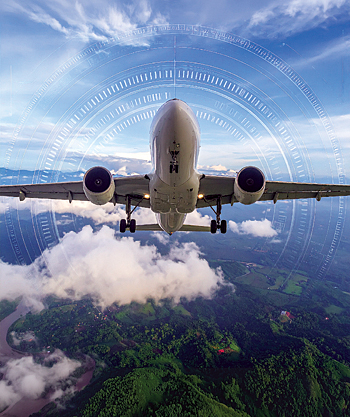
In today’s digital world, aviation is being transformed by artificial intelligence and emerging quantum computing, delivering major efficiency and safety gains while simultaneously creating new security, safety, and cyber risks that demand proactive, coordinated, and futureready mitigation strategies
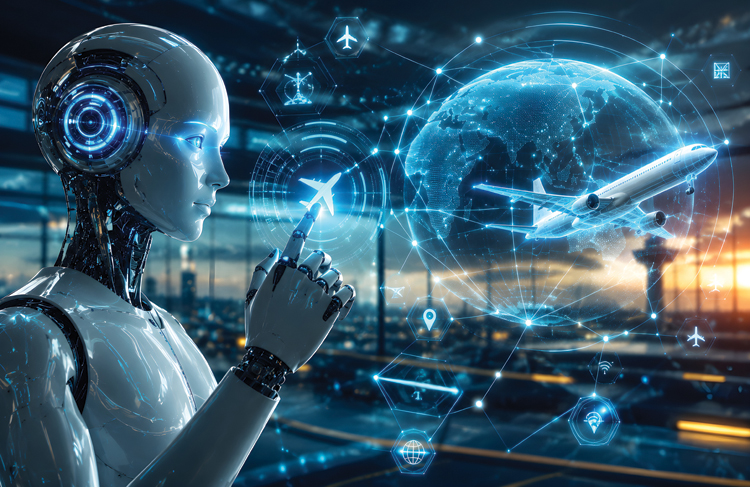
AI and connectivity are reshaping every layer of modern flight operations
The first controlled, powered, heavier-than-air aeroplane flew on December 17, 1903. This was a basic mechanical machine with no computing power. The progression of computing power from then to the contemporary systems has profoundly transformed the field of aviation. It has enhanced efficiency, automation, and connectivity. A technological revolution is taking place in the aviation industry. This revolution is being driven by artificial intelligence (AI) and Quantum Computing (QC). Integration of these technologies has become an operational reality. Artificial intelligence (AI) is well embedded in aircraft operations, while Quantum Computing (QC) is still experimental but set to change things in a big way.
These developments promise unprecedented operational optimisations and efficiency. While these technologies promise extraordinary benefits, they also introduce some security and safety challenges. AI systems are also vulnerable to attacks by adversaries. Quantum computers threaten to render current encryption obsolete. Securing the global airspace requires a paradigm shift from traditional defences to a proactive, data-centric security posture.
AI-driven systems now guide flight paths and airport operations worldwide
IMPACT OF AI AND QUANTUM COMPUTING ON AVIATION
Artificial Intelligence (AI). The impact of AI is visible across every facet of flight operations, safety, and security. AI applications and their benefits include the following:
- Flight Optimisation: Machine learning algorithms now manage complex Air Traffic Management (ATM) systems, optimising flight paths in real-time to reduce fuel consumption and minimise delays. AI improves fuel consumption by 10 per cent and emissions by optimising routes and managing outages.
- Predictive Maintenance: AI enables the evaluation of sensor data to predict failures, thereby increasing reliability and reducing expenses.
- Airport Performance: AI optimises check-in, baggage handling, and air traffic control, enhancing passenger journeys.
- Security: AI can operate advanced screening systems at airports. It can detect prohibited items through image recognition. Its accuracy is higher than that of human inspectors. AIenabled biometric systems can digitally streamline passenger identity processing and verification.
- Autonomous Flight and Pilot Support: AI autopilot and co-pilot technologies can handle standard flying functions. They can further reduce pilot workload by optimising emergency responses.
- Design Innovation: Generative AI can hasten the aerodynamic and material design process.
QUANTUM COMPUTING (QC)
Though still nascent, it offers complementary advancements.
- Operational Optimisation: QC optimises complex logistics issues (e.g., routing, cargo loading), potentially saving billions. Quantum algorithms can solve optimisation problems—such as crew scheduling and fleet routing—that are computationally impossible for classical computers. Quantum sensors could improve navigation precision, and quantum machine learning might enhance predictive analytics.
- Sustainable Aviation: QC optimises computational fluid dynamics (CFD) and structural analysis for light, efficient airframes. Quantum simulation is accelerating the development of lighter, more durable composite materials and highefficiency battery technologies for electric aircraft. Simulates new materials and fuels for hybrid/electric propulsion.
Artificial intelligence (AI) is well embedded in aircraft operations, while Quantum Computing (QC) is still experimental but set to change things in a big way
SECURITY AND SAFETY RISKS
Despite their advantages, AI and quantum computing introduce significant risks to aviation security and safety.
AI-related Risks. These primarily stem from vulnerabilities in machine learning models. Adversarial attacks—subtle manipulations of input data—can fool AI systems, such as causing airport security scanners to misidentify threats or disrupting AI-managed air traffic control. In autonomous or semi-autonomous systems, like advanced flight control, biased training data or “hallucinations” in generative AI could lead to erroneous decisions, compromising safety.
Quantum Risks. Quantum computing has the potential to become an existential threat to current cryptography. A large amount of data can be processed much faster using quantum algorithms. This can pose a risk to the encryption used to secure aviation systems. It could adversely affect communications, air-ground links, satellite navigation, and avionics data exchange. “Harvest now, decrypt later” attacks—where adversaries collect encrypted data today for future quantum decryption—jeopardise long-lived sensitive information, such as flight plans or maintenance records.
Cyber Threats. These threats are escalating as aviation systems become increasingly interconnected through IoT and 5G. AI-powered cyberattacks, where malicious actors use AI to probe defences or automate phishing, target airlines and airports. Data breaches in passenger systems or operational networks could erode trust and cause disruptions.
Balancing innovation and risk as smarter skies bring new vulnerabilities alongside AI-driven efficiency gains
Security Risks. Security risks include the following:
- Data Poisoning and Adversarial Attacks: AI inputs are susceptible to malicious manipulation. This could adversely affect flight controls, navigation, or airport functionality.
- System Vulnerabilities: Ageing systems can become susceptible to AI-based cyberattacks.
- Generative AI Threats: AI might be used to evade security by creating deceptive data.
- Encryption Threats: QC algorithms might compromise public-key cryptography. This could lead to data breaches or spoofed signals.
- Complex Attack Surfaces: Multiple layers of interconnected networks and avionics increase the vulnerability to quantum attacks.
Safety Risks. Safety risks include: - Algorithmic Errors: Algorithmic errors can result in AI bias or data misinterpretation. This can lead to incorrect autopilot or navigation commands, causing an accident.
- Over-Reliance: Excessive reliance on AI can negatively impact pilot proficiency. On the other hand, in-flight analysis can help strengthen safety.
- Semi-Autonomous Systems: Failure of autonomous operations can be disastrous.
- Simulation Errors: Errors in QC simulation can lead to defective designs and unsafe systems.
- Cyber-Driven Safety Critical Hazards: Critical navigation and avionics systems can be disrupted by Quantum and AI-driven cyberattacks. This could lead to failures and unsafe operations.
Securing the global airspace requires a paradigm shift from traditional defences to a proactive, data-centric security posture
MITIGATION STRATEGIES
Addressing these risks requires layered and forward-thinking strategies. The mitigatmitigating strategies need to be all-encompassing, including technology, regulation, and collaboration. Mitigation Strategies include:
- Post-Quantum Cryptography (PQC): Shift to quantumresistant algorithms would be required to protect avionics, communications, and air traffic control.
- Quantum Key Distribution (QKD): QKD would be required for unbreakable encryption in high-priority systems such as ADS-B.
- Resilient AI Governance: This would include building explainable AI frameworks, ongoing validation, and adversarial testing. It would make it transparent and minimise errors.
- Redundant Systems: Classical backups would need to be kept safe to mitigate AI or QC failures.
- Regulatory Harmonisation: Global aviation standards would need to be enhanced. These would have to be applied to AI and QC certification, prioritising safety, interoperability, and workforce training.
- Security by Design: Quantum-resistant architectures and layered cyber defence would be required in avionics and communications.
- Automated with Human in the Loop: Implement AIenabled automation (such as SOAR) to enhance response time while leveraging a human in the process to limit escalation.
CONCLUSION
Aviation’s future is brighter yet more precarious in an AI and quantum-driven world. These technologies can make flying safer and more sustainable. However, the safety and security of aviation stand at risk from associated threats. These risks can be alleviated by proactively adopting mitigating measures. All stakeholders need to invest in them now. The aviation industry needs caution and innovation to ensure safe skies in future.