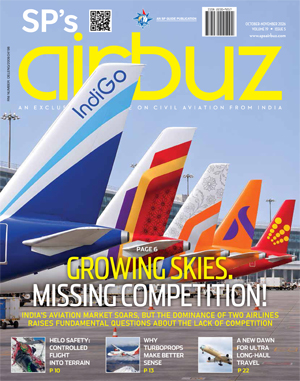





As India’s aviation landscape evolves, it presents a distinct set of challenges and opportunities. Commercial aviation remains dominated by two airlines, making the sector vulnerable to disruptions. Meanwhile, regional aviation is gaining momentum, backed by government policies, significant aircraft orders and progress in indigenous regional aircraft manufacturing programmes.

India’s aviation market is expanding rapidly, but competition has narrowed. IndiGo held nearly two-third of domestic market in June 2026, while the Air India Group had close to 25 per cent, leaving two groups with roughly nine out of ten passengers. In this article, Sarthak Baranwal traces this concentration to airline failures and consolidation, examines its implications for fares, choice and resilience, and considers barriers facing new entrants. It argues for policies that enable competitors without constraining successful airlines.
Over the past few-years, helicopters have seen a spate of accidents, across the globe. Through an imagined helicopter pilot’s experience, Manoj Kumar Singh, a veteran Helicopter Pilot himself, explains how controlled flight into terrain (CFIT) occurs when a serviceable helicopter is flown into the ground, often after pressing on in poor visibility. The account highlights weather limits, autopilot dependence and crew resource management, urging pilots to turn back rather than accept avoidable risks.
Looking into India’s burgeoning Regional Aviation market, we first have a feature on what makes Turboprop aircraft better suited than regional jets for short-haul operations. On sectors under 500 kilometres, their efficiency at lower speeds and altitudes can reduce fuel burn by 30–50 per cent, while shorter runway requirements widen network access. Smaller capacity helps airlines match seats to demand and sustain frequency. Using ATR aircraft as the benchmark, it explains why turboprops remain commercially relevant, flexible and efficient despite the speed of regional jets.
In a related feature, we take an in-depth look into India’s regional aviation ambitions that is gathering momentum through Modified UDAN, aircraft demand forecasts and domestic manufacturing plans. FLY91’s 40-aircraft ATR order illustrates the opportunity, while forecasts from ATR and Embraer indicate substantial demand. The article also looks at the various indigenous programmes, including the SJ-100, E175, Dornier 228 and Saras Mk2, while highlighting the execution challenges that lie ahead.
The Airbus A350F’s first flight started its certification campaign as Airbus prepares to reenter the large-freighter market. With cargo aircraft ageing and replacement demand rising, it has secured 115 orders and could enter service in 2027, ahead of Boeing’s delayed 777-8F. The article by Sarthak Baranwal outlines its design, payload, range and testing, while noting that certification and promised efficiency gains remain unproven.
Qantas’ Project Sunrise aims to enable nonstop flights between Australia and distant cities including London and New York using the Airbus A350-1000ULR. Upon successful completion of the test-flight, Sarthak Baranwal examines how the project could strengthen point-to-point travel, reduce reliance on connecting hubs and shape future aircraft design for future long-haul cabins.
All this and more in this issue of SP’s AirBuz. Welcome aboard and we wish you many happy landings!