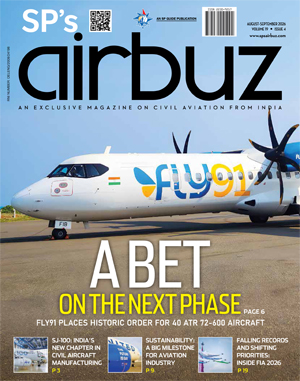




Farnborough International Airshow 2026 (July 20–24, 2026) returns as its biggest edition yet — sold-out halls, a sixth exhibition space, 28 country pavilions and 1,00,000+ visitors expected. Commercial aviation takes centre stage amid record order backlogs, delivery pressures, tightening SAF mandates, and a landmark debut for electric air taxis and advanced air mobility.

Recently, the European Union Aviation Safety Agency (EASA) issued a directive mandating inspections of 16 Airbus A380 aircraft after cracks were detected in wing mid-spar structural components. Sarthak Baranwal explains that the inspections are precautionary and reflect the aviation industry’s rigorous approach to monitoring ageing aircraft rather than an immediate safety concern. The article highlights that the directive underscores the importance of continuous airworthiness oversight, with minimal expected operational disruption and sustained confidence in the A380’s long-term service future.
In an exclusive interview with Alexis Vidal, Senior Vice President Commercial, ATR, we explore the growing relevance of turboprop aircraft in regional aviation. Vidal explains how ATR combines lower operating costs, fuel efficiency and sustainability to connect underserved markets, particularly in countries such as India. He discusses the advantages of turboprops over regional jets, technological advancements in engines, avionics and passenger comfort, and ATR’s use of AI, 3D printing and Sustainable Aviation Fuel (SAF). The interview also outlines ATR’s long-term environmental roadmap, including hybrid-electric propulsion, while highlighting the company’s commitment to expanding regional connectivity and supporting aviation’s journey towards net-zero emissions.
A preview of the upcoming Farnborough International Airshow (FIA) 2026, highlights its unprecedented scale, record exhibitor participation and expanding international presence. Rohit Goel talks about the show’s evolution into a platform that extends beyond aircraft displays to encompass finance, artificial intelligence, sustainability and advanced air mobility. Alongside major announcements from leading aerospace manufacturers, the event is expected to showcase first-time flying demonstrations of eVTOL aircraft, increasing emphasis on Sustainable Aviation Fuel (SAF), and discussions around supply-chain resilience and production challenges. FIA 2026 will serve as a global barometer for the future direction of commercial aviation, aerospace innovation and investment.
In another article, Rohit Goel analyses the continued expansion of India’s air cargo industry in 2026, driven by strong exports, booming e-commerce, growing manufacturing and sustained infrastructure investment. It highlights the sector’s transformation into a strategic component of India’s trade and logistics ecosystem, supported by improved airport infrastructure, digitalisation, expanded airline capacity and dedicated freighter operations. While exports remain the primary growth engine, domestic express logistics and regional connectivity are creating new opportunities.
Also, Rohit Goel reports on the Government of India’s expanded UDAN 2.0 scheme, that has evolved from a regional connectivity initiative into a strategic industrial policy for the civil aviation sector. Backed by a ₹28,840 crore allocation over ten years, the programme aims to develop new airports and heliports while creating sustained demand for smaller regional aircraft.
All this and more in this issue of SP’s AirBuz. Welcome aboard and we wish you many happy landings!