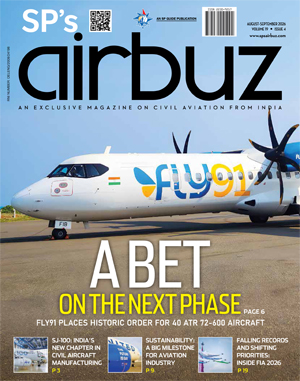





FLY91, an Indian regional carrier, recently placed an order for 40 ATR 72-600 aircraft valued at approximately $1 billion — the largest such order globally by a regional airline. This shows that regional aviation in India is a huge market and if nurtured properly, can sustain dedicated carriers by itself.

Goa-based FLY91 has built its entire strategy around the ATR 72-600, prizing its low costs, fuel efficiency and short-runway capability for underserved Tier II/III routes. Having flown 15,000+ flights to 13 destinations, the airline placed a $1-billion order for 40 more ATR 72-600s — the largest such order globally by a regional carrier — taking its fleet from six to over 60. Rather than chasing coverage, FLY91 targets the “sweet spot” between genuine connectivity gaps and commercial viability, expanding bases progressively as UDAN 2.0 fuels demand for smaller regional aircraft across India. Sarthak Baranwal takes a deep look into how FLY91 and ATR are together developing regional aviation in India.
In the first article, Manish Kumar Jha explains how India can benefit from the Russian push toward a deeper aviation partnership, with UAC and HAL finalising a licensing deal to build the SJ-100 locally, alongside separate orders for 105 Il-114-300 turboprops from three Indian startups. If India localises design, certification and manufacturing rather than mere assembly, the programme could seed a genuine domestic civil-aircraft industry.
In another article by Sarthak Baranwal, he looks at how in chasing net-zero by 2050, aviation is pursuing multiple parallel paths: Sustainable Aviation Fuel (SAF) as the near-term bridge, fleet renewal and radical new engine architectures like CFM’s open-fan RISE programme for efficiency gains, and hydrogen or hybrid-electric propulsion as longer-term bets. SAF remains two-to-four times costlier than jet fuel and supply-constrained, pushing airlines into long-term off-take deals while regulations like ReFuelEU mandate blending.
Technology is now deeply embedded the entire aviation sector. Anil Khosla details on the use of AI across aviation — optimising flight paths, predictive maintenance, airport operations, security screening and pilot support — while quantum computing, still nascent, promises gains in logistics, materials and sustainable aircraft design. But these technologies bring new risks: adversarial attacks on AI systems, algorithmic errors, over-reliance eroding pilot skills, and quantum computers’ potential to break today’s encryption, exposing navigation and communications data via “harvest now, decrypt later” attacks.
Farnborough International Airshow 2026 became its largest edition ever, drawing 1,41,580 visitors from 136 countries and a sixth exhibition hall. Commercial deals topped $84.7 billion with 353 firm orders, led by Boeing’s narrow win over Airbus and SMBC Aviation Capital’s blockbuster 200-jet order — though totals trailed forecasts amid production and engine-supply bottlenecks. Beyond metal, the show revealed a broadening ecosystem: newcomers in AI, finance and supply-chain logistics, Vertical Aerospace’s historic public eVTOL flight, and a new Finance Summit — signalling that aviation’s centre of gravity is shifting toward software, financing and electric aircraft. A show report is included in this issue.
All this and more in this issue of SP’s AirBuz. Welcome aboard and we wish you many happy landings!