





In flying, whether fixed wing or rotary wing aircraft, ‘Safety’ is paramount. The price of a deliberate wrong decision, by the Pilot, could be your Life.
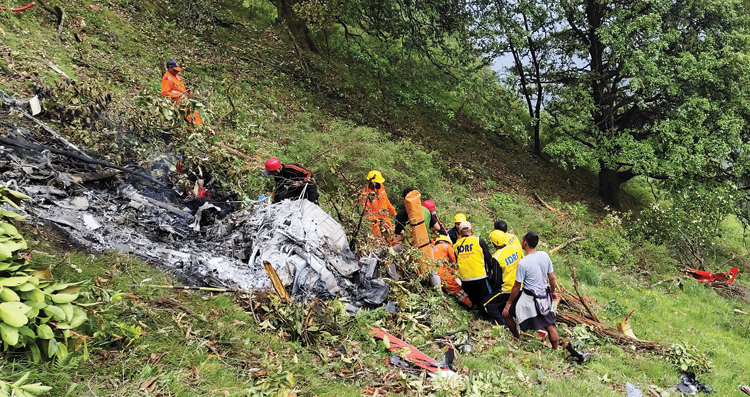
Most fatal helicopter accidents in India are caused by Controlled Flight Into Terrain (CFIT), when a pilot inadvertently flies a fully serviceable aircraft into the ground. This conceptualised narrative, told through an imaginary pilot, shows how it unfolds.
TWO WAYS TO FLY
I was a helicopter pilot with two ways to fly. Under Visual Flight Rules (VFR), I kept the ground and terrain in sight, in Visual Meteorological Conditions (VMC). Apart from distance from cloud, VFR needs visibility of 1 to 5 km below 3,000 feet, 5 km from 3,000 to 10,000 feet, and 8 km above that. Under Instrument Flight Rules (IFR), I flew solely on instruments with autopilot when the ground was barely visible or invisible, in Instrument Meteorological Conditions (IMC). Anything below VFR is IMC, and I knew CFIT occurs when a pilot tries to fly visually in IMC.
A HELICOPTER IS NOT AN AEROPLANE
An aeroplane flies between airfields with ground aids to touchdown, along predetermined obstruction-free routes, with weather information for higher altitudes. Flying between helipads, I had none of these luxuries: no ground aids, no safe routes or altitudes, no weather information near the ground. Across most of India, smoke, fog, smog or dust leave visibility marginal or poor near the ground, making takeoff and landing difficult even when the air above is clear.
THE LIMITS OF A SINGLE ENGINE
Single-engine helicopters are as safe as multi-engine ones over normal terrain in visual conditions. The difference shows in hostile environments, weather below visual limits and emergencies. A hostile environment is one where a safe forced landing cannot be made, occupants cannot be protected from the elements, search and rescue is inadequate for the exposure, or people and property on the ground face unacceptable risk.
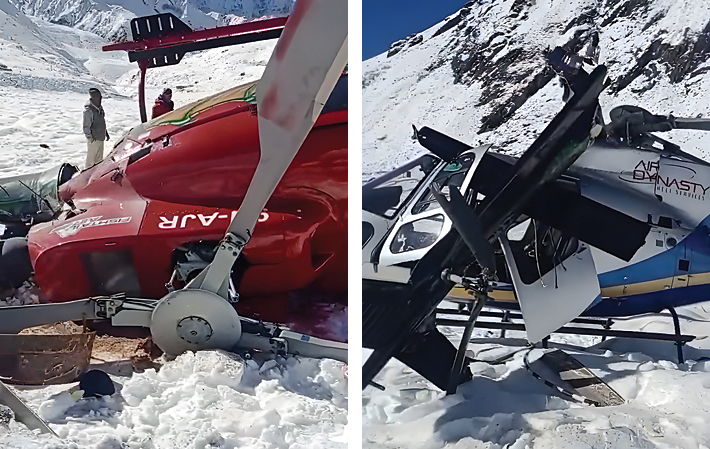
DGCA’s CAR 8-O-IV (para 3.1.2) requires helicopters, where safe continuation after a critical engine failure is not ensured, to fly in weather, light and routes that permit a safe forced landing. All single-engine helicopters in India are Performance Class 3: if the engine fails at any point, a forced landing must be made. They cannot fly over hostile terrain, where any engine malfunction would be fatal.
They are also generally certified only for VFR. Equipping them for IMC is possible, but operators prefer to save the cost. Performance Class 3 operations in IMC, except Special VFR, require IFR certification and the additional requirements of Appendix “F” of CAR 8-O-IV, which no single-engine helicopter in India satisfies.
HOW I FLEW
Flying between helipads had to be visual. The cardinal principle of manual visual flying is to keep the ground visible at all times for 100 per cent orientation. Followed strictly, most flying in India would stop. So I flew a mix: take-off and landing visual, the cruise on instruments. I knew most CFIT accidents occur in the landing phase, when the pilot disconnects the autopilot, moves from instrument to visual flying and lands manually.
Each escape cemented my belief that it was the right way. I did not realise it takes only one time. Like the rats of the Pied Piper, I followed until my luck ran out and, for the first and last time, I saw the ground flying towards me.
Flying a helicopter manually in poor visibility, without IFR instruments and autopilot, is like a 3D video game in which you must keep a ball, bouncing in all three axes, at the centre of a room. It is hard enough from outside with a stick. Now sit inside the ball, feeling sudden gravitational forces with every input. You might hold it for seconds, not beyond. Imagine doing it for a considerable time.
I always checked the weather before flight, yet what looked favourable on departure often turned unfavourable by landing, and in the air I had few means of knowing. Even knowing it was bad, I flew on, used tricks and somehow landed. I knew the thumb rule for hilly terrain: keep one of three out, hill, haze or helicopter.
WHY DID I FLY INTO THE GROUND? THE THREE PS!
AUTOPILOT AND THE POINT OF NO RETURN
With advanced avionics, IFR equipment and autopilot, I could fly hands-off, like an aeroplane, through zero visibility for hundreds of miles. That emboldened me to cross the forbidden line. With destination weather clear but en-route weather obscured, I flew on instruments for long stretches with no terrain visible, while technically flying VFR.
Short of destination, protocol required me to descend under manual control, since in hills it is neither advisable nor practical to stay on autopilot close to the ground. I switched to manual and landed with the site in view. I never terminated a sortie for any reason, technical or weather. It earned me a false reputation and management’s regard. By God’s grace I walked home every day, till one day.
THE DAY IT ENDED
With that reputation, I was tasked to fly a very important VIP in a single-engine helicopter as a single pilot. Timing, route and weather were all bad: a clear no-go. My company left the decision to me alone as captain. Conditioned as a yes-man, I said yes. As always, I rode my luck, flying most of the climb and cruise over hostile terrain with no safe space for a forced landing. Short of destination, the weather turned ugly and manual flying became virtually impossible. I had the clear option to climb away and return to safe ground. I continued, sure I would see the ground and land as always. I wondered how I would justify returning after coming so far, and dreaded explaining the abort to the VIP and management. So I tried different tricks to land.
With no visual clues, I was in that video game, close to terrain at about 100 km an hour, playing with my life and my passengers’. In the final phase I had to sight the ground. When I could not, panic set in. I committed the deadly sin of flying manually on instruments while searching outside for the ground, a cocktail of visual and instrument flying. With my attention off the instruments, I inadvertently banked and began descending without knowing it.
In commercial flying, pilots must overcome the fear of losing a job for taking the right stand, and fear losing their lives for not taking it
My alert co-pilot called, “turning right and descending.” I did not respond. He called again, louder. Nothing. I tried to read my altitude and, to my horror, could not even find the altimeter. I was fully disoriented and the helicopter was out of control.
The co-pilot should have taken over, but he assumed I, being so experienced, would recover. He did not realise the fog was not just outside; my brain was fogged too. I could not blame him. I had never paid attention to good CRM, or briefed him to take the controls if I was disoriented and failed to respond.
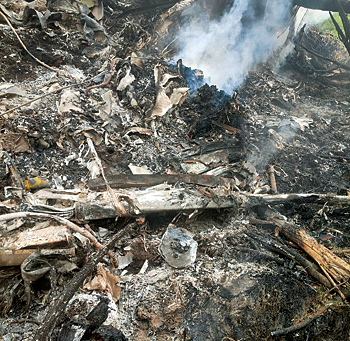
Then I saw what no helicopter pilot wants to see: tall trees on a hillock rushing towards me. I had cooked myself in a pressure cooker after rejecting the safety valve of getting away. The impact shattered the dreams, aspirations and lives of the families of everyone who flew with me, confident in my ability to look after their safety, which I did not.
THE FLIGHT PATH I DID NOT FOLLOW, BUT YOU SHOULD
Reduce the three Ps. Never knowingly get into a situation where you are not supposed to be. In commercial flying, pilots must overcome the fear of losing a job for taking the right stand, and fear losing their lives for not taking it. Operators must be sensitive to pilots who decline sorties fraught with undue risk.
A pilot’s motto should be: “Fly to live another day; a job will surely come our way.” Fear the loss of a job and take the pressures, and we may lose both job and life.
This is an imaginary, yet potentially real story of every helicopter pilot, conceptualised and written by a veteran helicopter pilot, retired from Indian Navy.