




CFM’s RISE programme is shaping Sustainable Aviation
CFM International — the 50/50 joint company between GE Aerospace and Safran Aircraft Engines — has spent more than four decades engineering engines that are cleaner, quieter, and more fuel-efficient, from the CFM56 family to today’s LEAP engines. According to CFM, its products already comply with ICAO’s strictest emissions and noise standards, and cumulative technology gains have cut carbon emissions from its engines by 40 per cent to date. That track record underpins CFM’s next major undertaking: the RISE programme.
WHAT IS RISE?
Launched on June 14, 2021, by GE Aerospace and Safran Aircraft Engines, RISE stands for “Revolutionary Innovation for Sustainable Engines.” CFM describes it as a technology demonstration programme — not a product for sale — aimed at maturing the building blocks for CFM’s next generation of engines, which the company expects could enter service in the second half of the 2030s. The headline target is ambitious: more than 20 per cent better fuel efficiency and correspondingly lower CO2 emissions compared with today’s most efficient commercial engines, alongside full compatibility with alternative energy sources. As CFM’s website puts it, RISE is “accelerating development of uncompromising new propulsion technologies that will pave the way for next generation aircraft.”
OPEN FAN: THE CENTERPIECE ARCHITECTURE
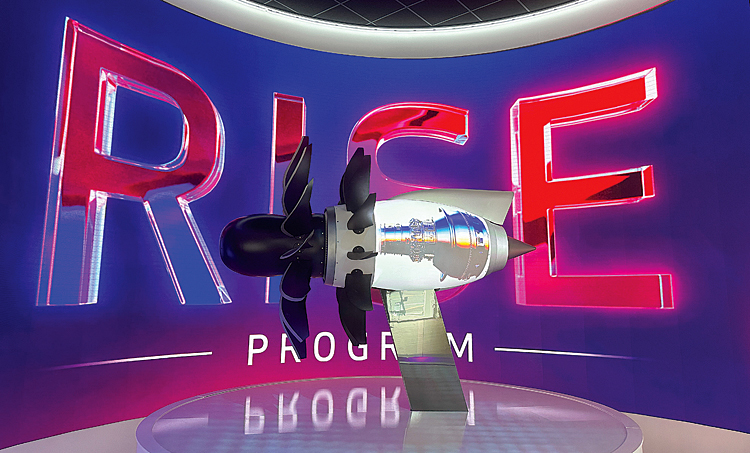
The most visible technology within RISE is the open fan engine architecture. CFM explains that decades of steadily growing engine fan diameters are “ultimately leading to the open fan concept,” which it considers “the most efficient and sustainable option” for improving propulsive efficiency. The design removes the traditional fan casing to allow a larger fan with less drag, using carbon-fiber composite blades manufactured through a 3-D weaving process. Notably, CFM says the open fan demonstrator will still cruise at the same speed as current single-aisle aircraft — up to Mach 0.8 — while meeting anticipated future noise regulations, meaning efficiency gains need not come at the cost of operational compatibility.
FUEL FLEXIBILITY: SAF AND HYDROGEN
Beyond engine architecture, RISE is engineered around fuel flexibility. CFM states its future engines will offer full compatibility with Sustainable Aviation Fuel (SAF) and hydrogen, which the company says could together enable up to an 80 per cent cut in CO2 emissions. CFM began testing SAF as early as 2006, and since 2016, airlines worldwide have flown more than 4,00,000 flights on CFM-powered aircraft using sustainable fuels. On hydrogen, CFM and Airbus separately announced a demonstration programme to ground- and flight-test a hydrogen-fueled engine — a modified GE Aerospace Passport™ turbofan on an A380 testbed — supporting a targeted zero-emission aircraft by 2035.
HYBRID-ELECTRIC POWER & ADVANCED MATERIALS
RISE also introduces hybrid-electric systems to single-aisle propulsion for the first time, according to CFM, allowing the engine to generate additional electric thrust while also producing electricity for onboard systems. This sits alongside an advanced “compact core” designed to boost thermal efficiency and cut fuel burn, built using next-generation metal alloys and ceramic matrix composites. Together, CFM frames these as the foundational technologies for any future CFM engine.
TESTING AT SCALE
CFM’s own reporting underscores the scale of validation work underway. The company cites more than 1,000 (and, in more recent updates, over 2,000) engineers dedicated to the programme, alongside roughly 500 test campaigns and over 3,000 endurance cycles completed as of mid-2026, spanning open fan, compact core, and hybrid-electric systems. In February 2026, CFM, Airbus, and Singapore’s Civil Aviation Authority signed an agreement to make Singapore’s Changi and Seletar airports the world’s first testbeds for evaluating how open fan aircraft would operate in real airport environments.
THE PATH AHEAD
CFM situates RISE within a broader industry pledge: in October 2021, CFM and its parent companies co-signed an Air Transport Action Group declaration committing global civil aviation to net-zero carbon emissions by 2050. CFM President & CEO Gaël Méheust has described RISE as central to that goal, framing it as a way of “pushing the technology envelope” to help the industry grow sustainably. Whether through open fan efficiency, SAF and hydrogen compatibility, or hybrid-electric power, RISE represents CFM’s most comprehensive attempt yet to decouple continued aviation growth from its historical emissions trajectory — a technology bet the company is now testing at genuine scale ahead of a next-generation engine planned for the mid-2030s.