




Airbus returns as the Freighter Market enters a new Fleet-Renewal Cycle
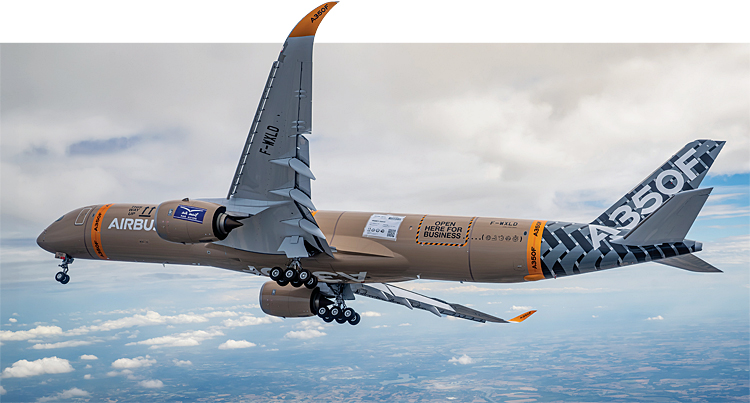
The Airbus A350F has flown for the first time, kicking off its certification campaign and putting the manufacturer a step closer to re-entering the large freighter market with a clean-sheet, purpose-built aircraft. MSN700, the first airframe, left Toulouse-Blagnac at roughly 10:30 local time on September 29 and stayed up for 4 hours and 10 minutes, climbing to about 25,000 feet before turning back to Toulouse. Airbus is aiming for certification in 2027, with entry into service to follow in the second half of that year under current plans.
Nothing dramatic was planned, and nothing dramatic happened. That was the point. The crew flew a set of pre-agreed test points over southern France, then made a low pass over Toulouse before landing. Five flight-test staff were aboard, among them experimental test pilots Bernardo Saez-Benito Hernandez and Sylvain Guiraud. Around 400 flight hours of certification flying now lie ahead of the team. MSN701, the second test aircraft, is still in final assembly and will carry a bigger share of the systems testing when it joins the programme later.
AN AGEING FREIGHTER FLEET
Timing matters here, because the world’s freighters are a lot older than its passenger jets. IATA puts the average cargo aircraft at 19.6 years old, against 12.8 years for passenger aircraft. That is a considerable gap between the two fleets. A good share of the freighters flying today will have to be replaced within the next two decades, and at the larger end of the market there are fewer suitable passenger aircraft left to convert into cargo carriers, too.
Airbus’s forecast has the dedicated freighter fleet growing to about 3,420 aircraft by 2044, which would need 2,605 new deliveries across the next 20 years. Some 1,530 of those would replace retiring aircraft, and the other 1,075 would add capacity as cargo traffic rises. Air-cargo traffic is forecast to grow around 3.3 per cent a year over that stretch.
The split is what counts for the A350F. Airbus sees demand for 630 new large widebody freighters, plus 855 mid-size widebodies and 1,120 smaller aircraft. Conversions of passenger aircraft are expected to make up 1,670 of the 2,605 deliveries, which leaves 935 new-build freighters. So the A350F targets a narrow slice of a much bigger replacement and growth market.
The order book already stands at 115 aircraft from 14 customers. Cargo operators, airlines and lessors are all on it, so buyers are lined up before certification is done. Airbus says that works out to as much as 59 per cent of the current large-freighter market, going by existing orders.
A GAP BEFORE THE 777-8F
Things get more interesting once the Boeing 777-8F enters the picture. The two are set to go head-to-head as the next generation of large twin-engine freighters, but Boeing’s aircraft is now expected to reach service later than the A350F does.
The 777-8F belongs to the broader 777X programme, which has been hit by delays in both development and certification. Boeing now aims to get the freighter into service around 2029, while Airbus wants A350F deliveries to start in the second half of 2027. If both programmes hold to their current schedules, the A350F could be carrying cargo for airlines about two years ahead of its Boeing rival.
In the meantime, the current 777F keeps filling the space. Boeing was recently granted an FAA waiver to sell up to 35 more 777Fs past the January 2028 emissions deadline, which lets it keep the existing production line running for longer while the 777-8F works through certification.
Operators planning their replacements get another choice out of this. Older 747Fs, 777Fs and converted aircraft won’t last forever, and new large freighters have been hard to come by in recent years. With an A350F in service in 2027, some airlines could well start retiring their older aircraft rather than waiting around for the 777-8F.
Don’t expect cargo networks to change overnight as such. Freighter fleets get renewed over several years, and operators will carry on mixing new-build aircraft, conversions and existing freighters for a good while yet. Still, the A350F hands the market one more new-build option just as replacement demand becomes a bigger factor for the whole industry.
A FREIGHTER BASED ON THE A350
Much of the A350F’s technology comes straight from the passenger A350 family, yet it isn’t simply an A350-1000 with the cabin stripped out. It takes the A350-1000’s wings and Rolls-Royce Trent XWB-97 engines, but the fuselage is a hybrid of the two types, with the A350-900’s forward section joined to the A350-1000’s rear fuselage.
The A350F measures 70.8 metres end to end, short of the A350-1000’s 73.78 metres. Airbus changed the length to suit the cargo configuration, centre-of-gravity needs and structural loads. The result has aerodynamics of its own, and those are among the things the flight-test programme will be examining.
Airbus’s forecast has the dedicated freighter fleet growing to about 3,420 aircraft by 2044, which would need 2,605 new deliveries across the next 20 years
The main-deck cargo door is another big departure. At roughly 4.3 metres wide and 3.15 metres high, it’s built to take oversized cargo. Airbus has also planned the loading sequence around the aircraft’s centre of gravity, so freight goes in from the rear and works its way forward.
Structural payload capacity is up to 111 tonnes, and the published range is 4,700 nautical miles with 109 tonnes on board. That is well short of what the passenger A350-1000 is capable of, but the two jets are designed for different operating needs. This one is about moving a heavy load efficiently over long-haul cargo routes, not about flying passengers as far as is physically possible.
Airlines that already run the A350 get a degree of commonality too. The same engine family, plus shared maintenance equipment and other support infrastructure, should make the freighter easier to slot into an existing A350 fleet than a completely new aircraft type would be.
THE CERTIFICATION CAMPAIGN
Much of the development work was done before MSN700 left the ground. Airbus ran 13 Virtual First Flight sessions on a development simulator wired to real aircraft avionics, among them the flight-control and digital engine-control systems. Airbus says the setup was about 90 per cent representative of the physical aircraft.
That gave Airbus a chance to try out systems and procedures well ahead of flight testing. MSN700 will now focus on aerodynamics, handling qualities, flight controls and the autopilot. Packed with flight-test instrumentation, it will feed back plenty of data on a broad range of systems and operating conditions.
MSN701 will lean more heavily towards aircraft systems. Its programme covers air conditioning, fire and smoke testing, and operations in both hot and cold conditions, while later stages bring in real cargo, pallets and loading equipment.
For a freighter these tests carry extra weight, since payload and range numbers tell only half the story of how the aircraft will perform. How cargo is loaded, whether pallets fit, how quickly the aircraft turns around and how it behaves at high weights all shape its usefulness in an airline’s network. Certification has to show that the aircraft flies as designed, and that it can do the work it was built for.
Airbus now has to turn the order book and the promised efficiency into a working product. The manufacturer says the A350F will burn up to 40 per cent less fuel and emit up to 40 per cent less CO2 than previous-generation freighters, while also meeting the latest ICAO emissions requirements for new aircraft.
The first flight proves none of those figures, and it doesn’t lock in the delivery schedule either. Flight testing, certification and cargo trials all still have to be completed before any customer can start operating the aircraft in service.
What the September 29 flight does show is that the A350F has entered the next phase of the programme. Between an ageing freighter fleet, rising replacement needs and a 777-8F that is still several years away, Airbus has a window to get its freighter established in the market before Boeing’s next-generation aircraft finally turns up.