




The government's expanded regional connectivity programme is fast emerging as a long-term catalyst for domestic civil aviation growth
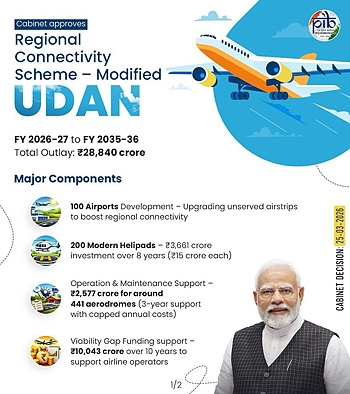
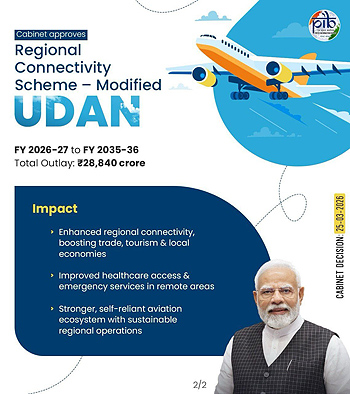
India's civil aviation sector may be on the cusp of a structural transformation, and the latest expansion of the UDAN scheme could well be the policy lever that drives it. With the Union Cabinet approving a ₹28,840 crore outlay for the modified UDAN framework for the period FY 2026-27 to FY 2035-36, the government has signalled that regional connectivity is no longer merely a public service objective. Instead, it is increasingly being positioned as a strategic instrument for industrial growth, infrastructure expansion and the development of a domestic aircraft manufacturing ecosystem.
By committing capital over a ten-year horizon and planning the development of 100 new airports and 200 helipads, the government is effectively creating a durable demand pipeline for smaller aircraft
For years, India has been recognised as one of the world's fastest-growing aviation markets. Passenger traffic has risen sharply, new airports have been built at an unprecedented pace and airline fleet sizes have expanded consistently. Yet, despite this growth, the country has largely remained dependent on imported aircraft platforms. The revised UDAN framework introduces a new possibility — that India's role in the aviation value chain may begin to evolve from being predominantly an operator and consumer market into a credible hub for regional aircraft manufacturing and associated aerospace capabilities. This shift is significant not just for civil aviation, but for India's broader industrial ambitions.
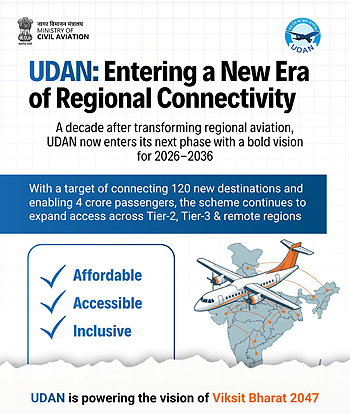
When UDAN was first launched, its principal aim was straightforward: make flying accessible to the common citizen by connecting underserved and un-served airports to the national network. The programme succeeded in opening up routes to smaller cities and remote regions that had long remained outside India's mainstream aviation map. The modified version, however, represents a more ambitious policy evolution.
With a decade-long financial commitment of ₹28,840 crore, the scheme now moves well beyond route subsidies and short-term connectivity goals. The scale of the allocation itself changes the nature of the programme. A long-term budgetary commitment of this magnitude provides visibility to airlines, airport developers, infrastructure companies and, crucially, manufacturers looking at India's regional aviation market.
Aircraft manufacturing decisions are fundamentally long-cycle investments. Companies do not establish production lines, supplier networks or assembly facilities on the basis of temporary demand spikes. They require sustained market certainty, and that is precisely what the revised UDAN framework begins to offer. By committing capital over a ten-year horizon and planning the development of 100 new airports and 200 helipads, the government is effectively creating a durable demand pipeline for smaller aircraft.
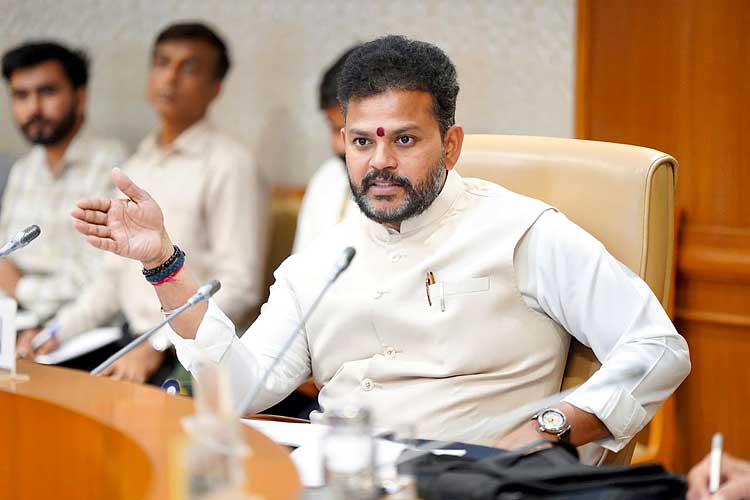
The clearest articulation of this industrial vision has come directly from Civil Aviation Minister Kinjarapu Rammohan Naidu, who has explicitly linked the enhanced allocation with the potential for domestic manufacturing. As the Minister stated, "the six-fold increase in UDAN allocation will improve access to smaller towns and drive demand for smaller aircraft, which could potentially spur local manufacturing." He further added that the increased demand would make "more business sense in local manufacturing in India for regional aircraft."
These remarks are important because they move the conversation beyond connectivity and place the scheme firmly within the framework of industrial policy. Rather than merely incentivising manufacturers through direct fiscal benefits, the government appears to be pursuing a more market-oriented approach — building demand at the route level so that manufacturing becomes commercially viable in its own right. This is a far stronger and more sustainable proposition.
The government appears to be pursuing a more market-oriented approach — building demand at the route level so that manufacturing becomes commercially viable
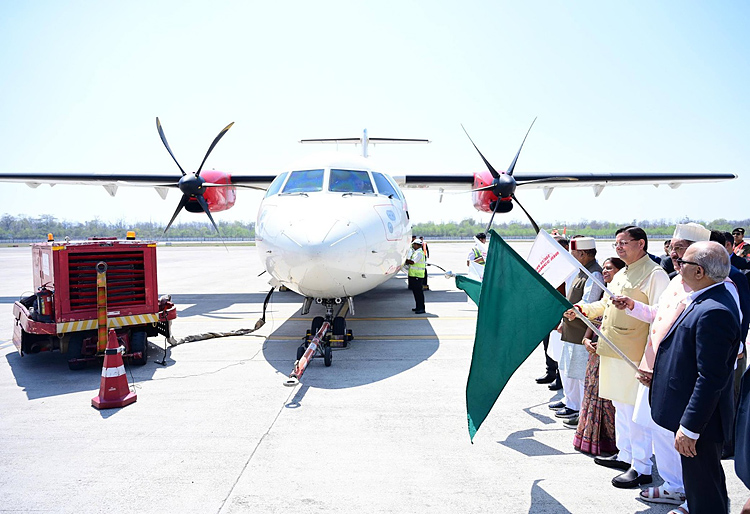
The expansion of regional connectivity naturally creates demand for a very different class of aircraft than those deployed on India's metro trunk routes. Flights connecting tier-II and tier-III cities, remote districts, hill states and smaller economic centres require aircraft that are optimised for short-haul sectors, thinner passenger loads and often shorter runways. These are not routes suited to larger narrow-body jets. Instead, they depend on commuter aircraft, regional turboprops and smaller short-haul platforms.
As more airports and heliports become operational under UDAN 2.0, the need for such aircraft is expected to rise steadily. This is where the manufacturing story begins to gather real momentum. Sustained route expansion in these sectors provides precisely the kind of recurring demand that can justify local assembly, component sourcing and eventually indigenous production. Once the economics begin to support manufacturing at scale, the impact is not limited to the aircraft itself. It extends across the entire aerospace supply chain.
The emergence of a regional aircraft manufacturing ecosystem in India would inevitably stimulate demand across multiple segments, including aerostructures, avionics, interiors, landing gear systems, electrical harnesses, maintenance services, pilot training and simulator support.
This wider ecosystem is where the real economic multiplier lies. A single production line can create demand for hundreds of suppliers, engineering firms and service providers. For India's industrial landscape, this means opportunities not only for large aerospace players but also for a wide network of MSMEs and Tier-1 suppliers.
The Minister has also emphasised in recent statements that India is moving towards becoming a country that not only flies aircraft but also designs, manufactures, maintains and finances them. That broader vision aligns closely with the national objective of strengthening self-reliance in advanced manufacturing sectors. For the civil aerospace sector, this could be a defining inflection point.
For much of the past decade, India's civil aviation story has been defined by market size and traffic growth. The revised UDAN framework introduces a deeper strategic dimension. It positions regional connectivity as a catalyst for industrial capability.
It is about creating the commercial and policy conditions necessary for India's aircraft manufacturing ambitions to take flight.
If the projected route expansion materialises as planned and traffic demand scales across emerging regional centres, the coming decade could see India evolve from being primarily an aviation consumer market into a meaningful manufacturing and assembly hub for smaller aircraft. That would mark a defining shift in the country's civil aviation narrative.
The latest allocation, therefore, is not just about connecting smaller towns to the national map. It is about creating the commercial and policy conditions necessary for India's aircraft manufacturing ambitions to take flight.
In that sense, UDAN 2.0 may ultimately be remembered not only for bringing aviation closer to the common citizen, but also for giving India's civil aerospace sector a credible and much-needed runway for long-term growth.