




IndiGo's rise is one of Indian aviation's great success stories. But as one carrier approaches two-thirds of the domestic market and two airline groups together account for roughly nine out of every ten passengers, India faces a larger question: can one of the world's fastest-growing aviation markets thrive without more meaningful competition?
There has perhaps never been a more exciting time for Indian civil aviation.
New airports are opening, existing ones are expanding and Indian carriers have placed some of the largest aircraft orders in aviation history. Cities that once sat at the margins of the country's aviation map are gaining scheduled services, while India's two largest airline groups are preparing for a future in which Indian carriers compete much more aggressively for international traffic.
The numbers tell the story of extraordinary growth. They also reveal a contradiction.
India's aviation market is expanding rapidly. Meaningful competition within it, however, has been shrinking.
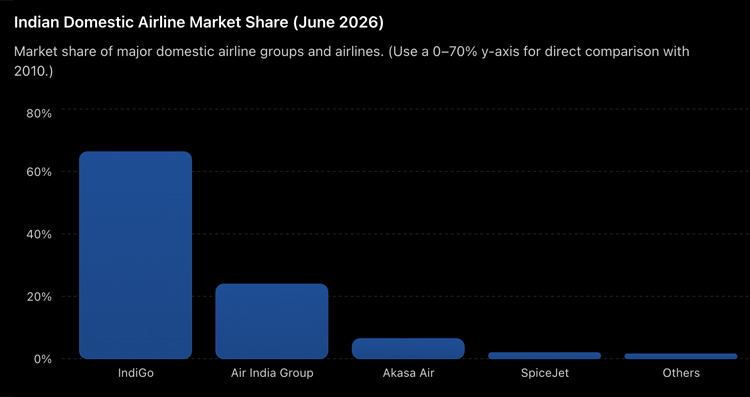
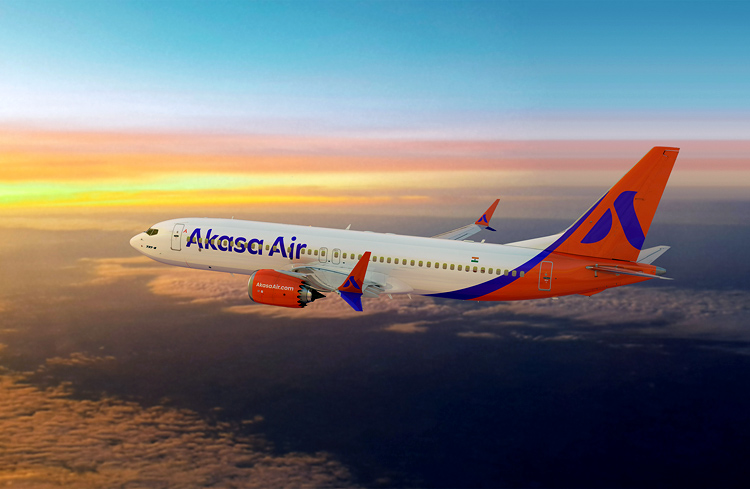
In June 2026, IndiGo carried 89.2 lakh domestic passengers and accounted for 66.3 per cent of the domestic market. The Air India Group accounted for another 23.9 per cent. Akasa Air, despite being less than four years old, had reached 6.4 per cent, while SpiceJet's share stood at 1.9 per cent.
Roughly nine out of every ten domestic passengers in India now fly with one of two airline groups
Put another way, roughly nine out of every ten domestic passengers in India now fly with one of two airline groups.
That deserves attention – but not because IndiGo has done something wrong.
If anything, IndiGo deserves considerable credit for reaching this position. Its rise has been built on nearly two decades of disciplined expansion, fleet commonality, high aircraft utilisation, cost control and an ability to execute consistently in an industry notorious for destroying capital. While several of its competitors faltered, IndiGo continued to add aircraft, destinations and frequencies.
The problem facing Indian aviation is therefore not that IndiGo became successful.
It is that too few airlines have managed to remain successful alongside it.
Go back to 2010 and the structure of Indian aviation was almost unrecognisable.
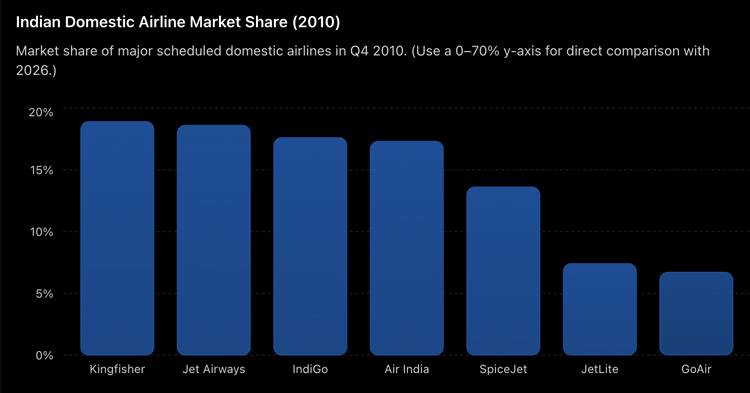
In the fourth quarter of that year, Kingfisher Airlines held 18.9 per cent of domestic traffic. Jet Airways had 18.6 per cent, IndiGo 17.6 per cent, Air India 17.3 per cent, SpiceJet 13.6 per cent, JetLite 7.4 per cent and GoAir 6.7 per cent.
No single airline controlled even a fifth of the market.
India has consequently travelled from a market where several airlines held shares in the teens to one where a single carrier holds close to two-thirds
The distinction matters. Several carriers were large enough to make genuinely independent decisions about fares, routes, capacity and service – and large enough for those decisions to influence their competitors.
Then, one by one, the landscape changed.
Kingfisher stopped flying in 2012. Jet Airways suspended operations in 2019. Go First ceased operations in 2023. SpiceJet survived, but at a considerably smaller scale.
Consolidation followed.
AIX Connect, formerly AirAsia India, merged into Air India Express in October 2024. Vistara merged into Air India the following month.
Meanwhile, IndiGo kept growing.
What emerged was not a market structure that any regulator necessarily designed. It was the cumulative result of airline failures, consolidation and one carrier executing its strategy far more consistently than almost everyone around it.
India has consequently travelled from a market where several airlines held shares in the teens to one where a single carrier holds close to two-thirds.
That does not make IndiGo a monopoly.
The distinction is important.
Air India, Air India Express, Akasa Air, SpiceJet and regional airlines continue to operate. On major trunk routes, passengers can still encounter meaningful competition.
National market share also tells only part of the story.
If large parts of India's aviation network depend disproportionately on one carrier, a disruption at that airline can quickly become a disruption to the wider transport system
A traveller does not buy a ticket for "Indian aviation"; he or she buys Delhi-Mumbai, Bengaluru-Hyderabad or Mumbai-Goa. A market can therefore be concentrated nationally while remaining fiercely competitive on particular city pairs. Equally, an airline with a relatively modest national share can hold enormous influence on an individual route.
That nuance should prevent the discussion from becoming an argument about IndiGo being "too big".
There is another factor.
IndiGo Managing Director Rahul Bhatia has argued that roughly a third of the airline's capacity is deployed on routes where no competing airline provides comparable connectivity. That is an important defence of its scale. An airline can hardly be criticised for serving destinations its competitors choose not to enter.
Yet the same argument reveals the underlying vulnerability.
If large parts of India's aviation network depend disproportionately on one carrier, a disruption at that airline can quickly become a disruption to the wider transport system.
The issue, then, is less about monopoly in the strict legal sense and more about concentration risk.
Every airline experiences disruption. Weather deteriorates. Aircraft go technical. IT systems fail. Crew availability becomes constrained. Airports close runways. Schedules unravel.
In a fragmented market, some of that disruption can be absorbed by competitors.
In a highly concentrated one, the system has less redundancy.
And redundancy matters.
Airline competition is often discussed almost entirely in terms of ticket prices. Its influence is considerably wider.
Put three or four serious airlines on the same route and they compete over departure times, frequency, baggage allowances, loyalty programmes, corporate contracts, connecting opportunities, punctuality and service.
A carrier considering reducing capacity must ask whether a rival will take its passengers. An airline raising fares knows another may add seats. A new product or service introduced by one operator can force others to respond.
This competitive pressure often works long before a regulator needs to become involved.
India therefore has the foundations of a formidable second airline group. What it does not yet have is an equally formidable third or fourth
A dominant airline does not have to abuse its position for concentration to matter. The simple existence of credible alternatives changes commercial behaviour.
This is why counting airline brands is not enough.
India needs several airlines with sufficient scale to influence one another.
And this is where the consolidation of the Tata airline portfolio becomes particularly interesting.
The privatisation of Air India was necessary.
India had spent years watching its national carrier struggle to realise its potential while foreign airlines captured enormous volumes of international traffic originating in the country. Tata's acquisition finally gave Air India access to private capital, large aircraft orders and a long-term commercial strategy.
Consolidating Tata's four-airline portfolio into two carriers also had strong business logic.
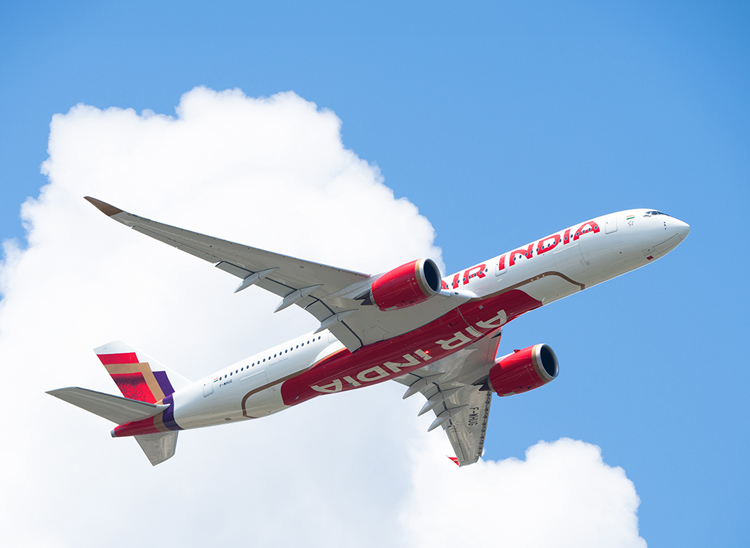
AIX Connect merged into Air India Express on October 1, 2024. Vistara merged into Air India on November 12. What had been four Tata-controlled airlines effectively became two: full-service Air India and low-cost Air India Express.
Running overlapping airlines brings duplication in management, crews, technology, sales, fleet structures and networks. Integration can eliminate much of that complexity while producing the scale required to compete with much larger global carriers.
The Competition Commission of India approved the Air India-Vistara combination in 2023.
Fewer substantial competitors mean fewer alternatives when disruption occurs. They can mean less aggressive capacity competition on certain routes and weaker pressure to improve products
Yet from a competition perspective, something else happened at the same time.
Two independent airline decision-makers disappeared.
Their aircraft did not vanish. Their employees did not vanish. Much of their capacity remained.
Their ability to compete independently did.
Vistara could no longer decide on its own to enter a route, add frequency, discount fares or introduce a product that forced Air India to respond. The same principle applied to AirAsia India after its integration with Air India Express.
This created an unusual paradox.
India may ultimately gain a much stronger challenger to IndiGo – something the market clearly needs – while simultaneously having fewer independent competitors.
The first outcome could be extremely positive.
The second should not be ignored.
Starting an airline is difficult almost everywhere. Building one in India adds a particular set of challenges
Air India's transformation also remains unfinished. In June 2026, the entire Air India Group held 23.9 per cent of the domestic market against IndiGo's 66.3 per cent. Tata Sons has acknowledged that the broader Air India turnaround could take years as it works through operational, financial, supply-chain and geopolitical challenges.
India therefore has the foundations of a formidable second airline group.
What it does not yet have is an equally formidable third or fourth.
For consumers, the immediate effects of concentration can be difficult to identify.
Flights continue to increase. Aircraft continue arriving. Competition on major routes can remain intense. Fares can still be attractive.
So why worry?
Because the consequences of concentration tend to emerge gradually.
Indian aviation has repeatedly demonstrated an uncomfortable truth: enormous passenger demand does not automatically translate into sustainable airline profits
Fewer substantial competitors mean fewer alternatives when disruption occurs. They can mean less aggressive capacity competition on certain routes and weaker pressure to improve products. They can also make it increasingly difficult for a newcomer to obtain the scale necessary to challenge established airlines.
None of this means fares must suddenly rise or service must deteriorate.
It means fewer competitive forces exist to prevent those outcomes.
And once a market becomes prohibitively difficult for newcomers to enter, restoring competition becomes much harder.
The United States provides an instructive example.
The American airline industry is itself highly concentrated, and decades of mergers produced several enormous carriers. It would be difficult to present it as an ideal model of aviation competition.
Yet American regulators have repeatedly demonstrated that there are limits to how far airline consolidation should go.
When American Airlines and US Airways sought to merge in 2013, the U.S. Department of Justice challenged the transaction. It was ultimately allowed to proceed, but only after the airlines agreed to surrender slots and facilities at important airports, including Washington Reagan and New York LaGuardia.
The logic was straightforward: competitors needed access to the infrastructure required to challenge the enlarged airline.
A decade later came an even more relevant example.
JetBlue proposed acquiring Spirit Airlines for $3.8 billion.
A start-up entering with ten or twenty aircraft is not merely competing against another airline. It is competing against a network
The combined carrier would still have been substantially smaller than America's largest airlines. Yet the Justice Department sued to stop the transaction, and a federal court blocked it in January 2024.
The significance of the case went beyond Spirit's size.
Spirit's ultra-low-cost model exerted pressure on the fares charged by larger airlines. Its competitive importance was therefore greater than its market share alone suggested.
Remove an independent competitor, the argument went, and you do not merely remove its aircraft. You remove the pressure its existence places on everybody else.
That principle is highly relevant to India.
The value of airlines such as Vistara, Go First, Jet Airways or even a smaller SpiceJet cannot be measured solely by the passengers they carried.
If practically every attractive slot remains permanently concentrated among incumbents, a newcomer may struggle to build a competitive network regardless of how well financed it is
Their presence affected what their competitors did.
Competition is sometimes most valuable precisely because of decisions that never happen: the fare increase an airline decides against, the frequency it chooses not to cut or the service improvement it makes because passengers have somewhere else to go.
If India needs stronger third and fourth competitors, the obvious question is why investors are not rushing to create them.
The answer lies in the economics of aviation.
Starting an airline is difficult almost everywhere. Building one in India adds a particular set of challenges.
Aircraft are expensive. Leasing and many major costs are dollar-denominated while a large portion of revenue is earned in rupees. Fuel is volatile and heavily taxed. Airport charges matter enormously in an exceptionally price-sensitive market. Aircraft and engine supply-chain problems can suddenly ground capacity, while pilots, engineers and other specialised personnel take years to train.
Indian aviation has repeatedly demonstrated an uncomfortable truth: enormous passenger demand does not automatically translate into sustainable airline profits.
Even IndiGo's leadership has called for reductions in aviation fuel taxes and airport charges to lower the structural cost of flying.
The objective should not be to take capacity away from successful airlines. It should be to ensure that infrastructure scarcity does not eventually make serious airline entry almost impossible
A new entrant then confronts another obstacle – scale.
IndiGo and Air India operate nationwide networks. They have established airport positions, sales organisations, corporate contracts, maintenance operations, loyalty programmes and aircraft order books measured in hundreds.
A start-up entering with ten or twenty aircraft is not merely competing against another airline.
It is competing against a network.
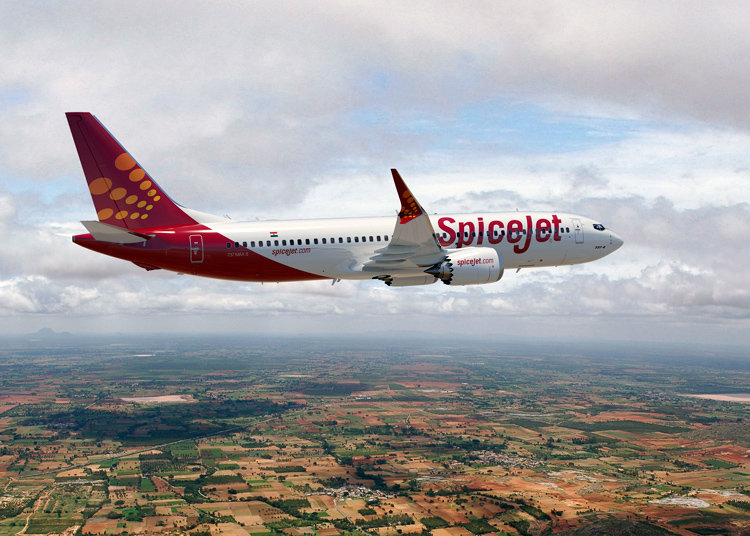
Akasa Air is important precisely because it demonstrates that entry is still possible. Having begun operations only in 2022, it had reached 6.4 per cent of the domestic market by June 2026.
For such a young carrier, that is meaningful progress.
India needs more stories like it.
Money and aircraft, however, are only part of what a new airline requires.
It also needs somewhere useful to fly them.
At India's busiest airports, commercially attractive slots are becoming increasingly valuable. An airline may possess aircraft, crews and passengers, but a 2:30 a.m. departure is not necessarily a meaningful alternative to an 8:00 a.m. flight for a business traveller.
This creates one of the most important long-term barriers to competition.
Historical slot allocation naturally benefits established airlines because they already operate the flights. Those airlines should not arbitrarily lose capacity simply because they have been successful.
But if practically every attractive slot remains permanently concentrated among incumbents, a newcomer may struggle to build a competitive network regardless of how well financed it is.
This is where India's airport expansion creates an unusual opportunity.
Noida International Airport and Navi Mumbai International Airport, alongside continued expansion elsewhere, represent more than additional terminals and runways. They represent new competitive capacity.
India arguably does not need another undercapitalised carrier entering with a handful of aircraft and hoping to survive a fare war. It needs investors capable of building scale
India should treat some of that capacity accordingly.
Transparent slot allocation, effective use-it-or-lose-it rules and genuine opportunities for new entrants could allow future airlines to establish meaningful schedules without unfairly penalising carriers that built the existing market.
The objective should not be to take capacity away from successful airlines. It should be to ensure that infrastructure scarcity does not eventually make serious airline entry almost impossible.
The issue became particularly interesting with recent discussion around whether India's rules restricting airport operators from owning airlines should be relaxed.
Such a change could theoretically open the door for groups such as Adani or GMR – already major participants in Indian airport infrastructure – to enter the airline business.
Adani Airport Holdings sought changes relating to restrictions at Mumbai airport that limit airline ownership, although the group subsequently stated in a stock-exchange filing that it had no plans to enter the airline business.
Whether either group ultimately wants an airline is almost secondary to the larger policy question.
On one side, companies of this scale possess exactly what a serious new Indian airline would require: substantial capital, infrastructure expertise and the ability to invest over a long period.
India cannot become so concerned about domestic concentration that it prevents its airlines from achieving the scale required to compete internationally
India arguably does not need another undercapitalised carrier entering with a handful of aircraft and hoping to survive a fare war.
It needs investors capable of building scale.
On the other side sits an obvious conflict-of-interest concern.
An airport operator controls infrastructure every airline requires – gates, stands, terminal facilities, check-in areas and operational space. At capacity-constrained airports, access itself becomes a valuable commercial resource.
If the same group also owned an airline, competitors would inevitably ask whether access remained completely neutral.
That does not necessarily mean airport operators should be permanently prohibited from entering the airline business. But any relaxation would require extremely strong safeguards: transparent airport charges, independent slot allocation, equal infrastructure access, protection of commercially sensitive information and close competition oversight.
India should be careful not to solve one concentration problem by creating another.
There is, however, an important counterpoint.
India cannot become so concerned about domestic concentration that it prevents its airlines from achieving the scale required to compete internationally.
For decades, a substantial portion of India's international traffic has flowed through foreign hubs – Dubai, Doha, Abu Dhabi, Singapore, Istanbul, Frankfurt and London among them.
Foreign network airlines built scale and connectivity that Indian carriers historically struggled to match.
That is finally beginning to change.
IndiGo is expanding internationally and gradually moving beyond the traditional boundaries of a short-haul low-cost carrier. Air India's transformation is explicitly aimed at rebuilding a major global network airline.
This is good for Indian aviation.
A larger IndiGo and a stronger Air India can retain more Indian-originating traffic, create domestic hubs, improve long-haul connectivity and give the country significantly greater influence in global aviation.
That creates the central policy tension.
India needs airlines large enough to compete with the world's aviation giants abroad, while simultaneously needing enough competition to keep its market healthy at home.
India needs airlines large enough to compete with the world's aviation giants abroad, while simultaneously needing enough competition to keep its market healthy at home
Those objectives do not have to contradict one another.
The answer is not to make IndiGo smaller.
Nor is it to prevent Air India from becoming larger.
It is to create an environment in which others have a realistic chance of growing alongside them.
This challenge is sometimes framed as one for the Directorate General of Civil Aviation. In reality, DGCA is only one part of the equation.
Its principal responsibility is aviation safety and operational oversight.
Competition involves a much wider collection of institutions.
The Ministry of Civil Aviation influences aviation policy. The Competition Commission of India examines mergers and market concentration. Airport operators and regulators influence infrastructure access and economics. Central and state governments influence taxation. Slot rules influence whether new airlines can build useful networks.
DGCA, meanwhile, must ensure that any airline entering or expanding in the market meets the necessary operational and safety standards.
That last requirement should remain non-negotiable.
Making India easier for airlines to enter cannot mean weakening safety, maintenance, training or financial oversight.
As new airports open and existing ones expand, slot policy should recognise that access to commercially useful timings can determine whether a newcomer succeeds or fails
The objective should instead be to remove unnecessary economic and administrative barriers while remaining uncompromising on safety.
There is no single policy capable of creating competition overnight.
But several measures together could make the market substantially more contestable.
Structural operating costs remain an obvious starting point. Aviation turbine fuel taxation and airport charges directly affect the economics of both existing airlines and potential entrants. A market in which only the largest operators can comfortably absorb structural inefficiencies will naturally become more concentrated.
Airport capacity is equally important. As new airports open and existing ones expand, slot policy should recognise that access to commercially useful timings can determine whether a newcomer succeeds or fails.
Future airline mergers also deserve careful scrutiny, not because consolidation is inherently undesirable but because airline competition is intensely route-specific. A transaction that appears harmless nationally can significantly reduce choice on individual city pairs.
India should also encourage different types of airlines rather than expecting every entrant to become another IndiGo.
A premium carrier, a regional airline, an ultra-low-cost operator and a conventional low-cost carrier can all create competitive pressure in different ways.
Healthy competition does not require five identical airlines.
It requires several independent companies making different commercial decisions.
Most importantly, policy should aim to make airline survival possible without artificially protecting poorly run businesses.
A premium carrier, a regional airline, an ultra-low-cost operator and a conventional low-cost carrier can all create competitive pressure in different ways
India's aviation history is littered with airlines that expanded aggressively, accumulated losses and eventually disappeared.
Keeping an unsustainable airline alive indefinitely does not create healthy competition.
Creating conditions in which a well-run airline can realistically survive does.
The next decade could take Indian aviation in two very different directions.
In the first, IndiGo continues expanding into a major global airline. Air India completes its transformation and becomes a powerful international network carrier. Akasa grows into a substantial third competitor. SpiceJet stabilises or rebuilds. One or two well-capitalised new airlines emerge, while regional carriers develop markets beyond India's largest metros.
New airports create enough capacity for those airlines to establish meaningful networks.
India would then achieve something it has rarely managed at the same time: large airlines, strong balance sheets and genuine competition.
There is another possibility.
IndiGo and Air India absorb most incremental capacity. Smaller airlines remain marginal. Prime airport slots become increasingly concentrated. The capital required to establish a nationwide challenger rises further.
India would still become one of the world's largest aviation markets.
It would simply do so as a market overwhelmingly dependent on two airline groups.
Its success demonstrates that an Indian carrier can build enormous scale without abandoning operational efficiency
Such a system might function perfectly well for years.
But it would also leave one of the world's most important aviation markets unusually exposed to the commercial and operational fortunes of two companies.
That distinction should sit at the centre of India's aviation debate.
IndiGo deserves enormous credit for what it has built.
It entered a market dominated by established names and, through consistency and discipline, became the airline everyone else had to chase. Its success demonstrates that an Indian carrier can build enormous scale without abandoning operational efficiency.
Restricting that success would make little sense.
Air India should likewise be given the opportunity to complete its transformation and build the global network India has long lacked.
But for a country of India's population, geography and economic ambition, two giants are not enough.
Aircraft orders alone do not create a healthy aviation industry.
Neither do passenger records, new terminals or ambitious traffic forecasts.
Competition does.
The lesson from India's past is not simply that the country once had too many airlines. Several of those carriers were financially fragile, and destructive competition helped create an industry in which spectacular growth frequently coexisted with spectacular losses.
The government must make aviation easier to enter without making it easier to fail. Competition authorities must recognise that even relatively small airlines can exert significant pressure on larger rivals
But the opposite extreme carries its own risks.
Too much competition without sustainable economics destroys airlines.
Too little competition eventually weakens the market around them.
India now has the opportunity to find the balance between the two.
The government must make aviation easier to enter without making it easier to fail. Competition authorities must recognise that even relatively small airlines can exert significant pressure on larger rivals. Airport policy must ensure that tomorrow's infrastructure does not simply reproduce today's market structure. DGCA must continue protecting safety while allowing responsible airlines to grow efficiently.
And investors entering Indian aviation must arrive with the capital and patience to build airlines over decades rather than chase market share for a few years.
India has already demonstrated that it can create one of the world's most successful low-cost airlines.
It may now be rebuilding a national carrier capable of competing with the world's best.
The next achievement should be creating an aviation ecosystem in which another serious challenger can emerge alongside them.
Because the strongest aviation market is not one where its largest airline is forced to become smaller.
It is one where its competitors are capable of becoming larger.