




India and France Elevate Ties to a Special Global Strategic Partnership, Charting a Horizon 2047 Roadmap for Strategic, Technological and Geopolitical Convergence
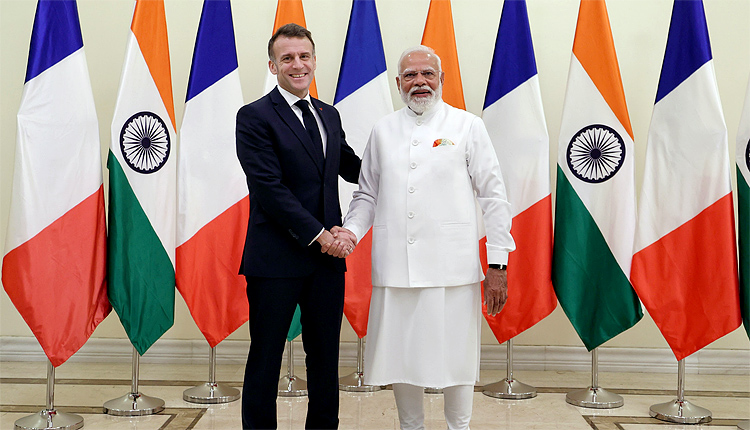
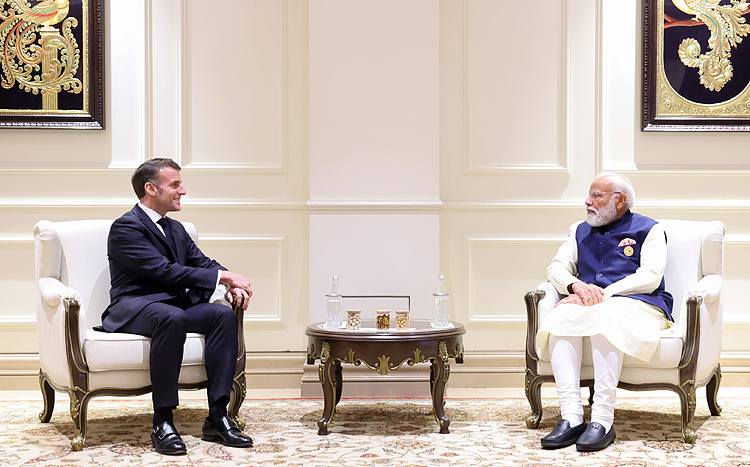
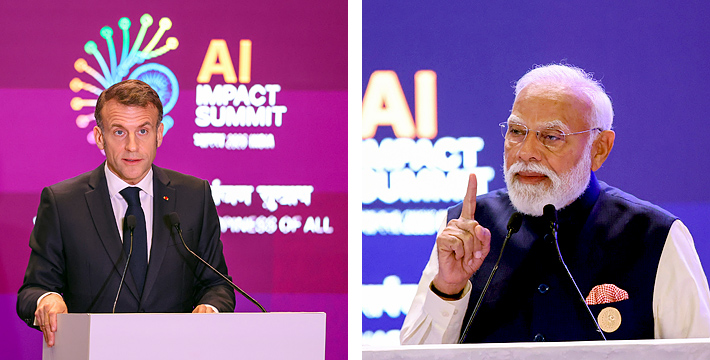
At the invitation of Prime Minister Narendra Modi, French President Emmanuel Macron paid an official visit to India from February 17–19, 2026, during which he participated in the Artificial Intelligence Impact Summit 2026 and held wide-ranging bilateral talks. The visit marked a defining moment in the relationship, with both leaders agreeing to elevate ties to a Special Global Strategic Partnership, signaling a long-term commitment to deeper cooperation across strategic, economic, technological and geopolitical domains.
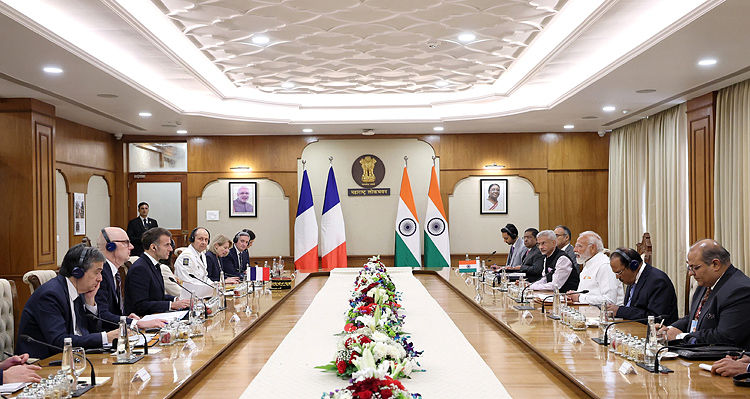
During the visit, the two leaders jointly inaugurated the 2026 India-France Year of Innovation in Mumbai, underscoring the centrality of science, research and emerging technologies to the next phase of the partnership. The decision to upgrade ties builds on 25 years of the Strategic Partnership, celebrated in 2023, when the two sides adopted the Horizon 2047 Roadmap. That roadmap charts cooperation through to 2047 — the centenary of India's independence, 100 years of diplomatic relations between the two countries, and 50 years of their Strategic Partnership.
Both leaders agree to elevate ties to a Special Global Strategic Partnership, signaling a long-term commitment to deeper cooperation
The elevation reflects a shared ambition to act as a force for global good — strengthening prosperity and resilience at home while contributing to a stable, rules-based international order. To ensure structured oversight of this expanded agenda, the leaders established an annual Foreign Ministers Comprehensive Dialogue to regularly review progress under the Special Global Strategic Partnership and the Horizon 2047 Roadmap, particularly in economic security, global governance and people-to-people exchanges.
India and France reaffirmed their shared commitment to a free, open and rules-based Indo-Pacific region. The upgraded partnership is intended to strengthen cooperation in future-facing sectors, reinforce sovereignty and decision-making autonomy, and enable joint responses to global challenges — including through closer engagement between India and the European Union.
Both leaders reiterated the importance of reformed and effective multilateralism. They stressed the urgent need to reform the United Nations Security Council and pledged to coordinate closely in multilateral forums, including on UNSC matters. France reiterated its firm support for India's permanent membership of the Security Council, and both sides agreed to intensify efforts to conclude intergovernmental negotiations on reform. They also supported discussions on regulating the use of the veto in cases of mass atrocities.
The two leaders jointly inaugurated the 2026 India-France Year of Innovation in Mumbai, underscoring the centrality of science, research and emerging technologies to the next phase of the partnership
On Europe, the leaders underlined the importance of stronger EU–India ties and welcomed the historic India–EU summit at which negotiations for the Free Trade Agreement were concluded. The FTA is expected to unlock expanded economic collaboration between India, France and Europe, enhance business competitiveness and strengthen resilient value chains. They also welcomed the conclusion of the Security and Defence Partnership between India and the EU, which provides a framework for cooperation in maritime security, cyber, hybrid threats, space and counterterrorism, while fostering defence industrial collaboration.
The leaders expressed concern over the war in Ukraine, stressing the need for cessation of hostilities and support for a comprehensive, just and lasting peace consistent with the UN Charter and principles of sovereignty and territorial integrity. They also discussed developments in Iran and the broader region, emphasising dialogue and diplomacy as the preferred path forward.
On Gaza, both leaders supported implementation of the Peace Plan in accordance with UN Security Council Resolution 2803 and the principles of the New York Declaration. They encouraged full implementation of the resolution, called for rapid, safe and unimpeded humanitarian assistance throughout Gaza, and reiterated their commitment to a just and lasting two-state solution achieved through dialogue and diplomacy.
Defence cooperation remains the backbone of the relationship and has evolved steadily toward co-design, co-development and co-production. Building on the Defence Industrial Roadmap agreed in 2024, Prime Minister Modi and President Macron agreed to intensify collaboration across air, naval and land systems, as well as emerging dual-use technologies.
They welcomed the signing in November 2025 of a Technical Arrangement between France's defence procurement agency (DGA) and India's DRDO, providing a framework for joint research and development. To further institutionalise high-technology cooperation, the two leaders agreed to constitute a Joint Advanced Technology Development Group to explore co-development of emerging and critical technologies in niche areas, with the aim of retaining a competitive military edge and mitigating supply chain vulnerabilities.
The two sides adopted the Horizon 2047 Roadmap. That roadmap charts cooperation through to 2047 — the centenary of India's independence, 100 years of diplomatic relations between the two countries, and 50 years of their Strategic Partnership
The leaders welcomed ongoing discussions to deepen cooperation in helicopter and jet engine development. They commended the contract for the procurement of 26 Rafale-Marine fighter jets and expressed their intent to expand defence aeronautics collaboration under the Make in India initiative, particularly in fighter aircraft and combat engine manufacturing.
They noted strong cooperation between the Safran group and Indian partners, including collaboration with HAL on the Indian Multi Role Helicopter (IMRH). Both sides welcomed the inauguration of Maintenance, Repair and Overhaul facilities for LEAP engines and for M88 engines used on Rafale aircraft, as well as the joint venture with Bharat Electronics Limited to produce HAMMER missiles in India.
Building on the Defence Industrial Roadmap agreed in 2024, Prime Minister Modi and President Macron agreed to intensify collaboration across air, naval and land systems, as well as emerging dual-use technologies
In a major milestone for India's aerospace manufacturing ecosystem, the two leaders jointly inaugurated the H125 Final Assembly Line — a first-of-its-kind private sector helicopter manufacturing facility in India, combining the strengths of TATA Advanced Systems and Airbus to serve domestic and export markets. Prime Minister Modi also appreciated growing French interest in India's Pinaka Multi Barrel Rocket Launcher system.
In the maritime domain, both leaders highlighted the success of the Scorpène submarine programme (P75 – Kalvari class), noting the delivery of the sixth submarine to the Indian Navy in January 2025 and welcoming continued cooperation in submarine development.
The two sides also emphasised operational cooperation, citing regular bilateral exercises — Varuna (naval), Shakti (army) and Garuda (air force) — and participation in multilateral exercises, including India's involvement in French space military exercises. They welcomed increased port calls, officer exchanges in 2026 and plans to expand operational engagement.
India and France reaffirmed their commitment to deepening cooperation in defence space, building on the Letter of Intent signed in January 2024. The DRDO–DGA Technical Arrangement includes defence space within its scope, facilitating innovative state-level and industrial cooperation.
In the civilian space domain, the leaders commended the strong partnership between CNES and ISRO and called for the early convening of the third session of the India-France Strategic Space Dialogue in 2026. They agreed to enhance cooperation on sovereign access to space and space situational awareness. India welcomed France's hosting of the International Space Summit in July 2026 and confirmed its participation.
President Macron lauded India's target of achieving 100 GW of nuclear power capacity by 2047 and recent reforms permitting private investment in the nuclear sector
In cyberspace, both sides highlighted the importance of regular cyber dialogue and coordination at the United Nations on the application of international law and responsible state behaviour. They underscored the need to address the proliferation of malicious cyber tools and practices.
The leaders unequivocally condemned terrorism and violent extremism in all forms, including cross-border terrorism. President Macron strongly condemned the April 2025 Pahalgam terror attack and the November 2025 terror incident near Red Fort in New Delhi, expressing support for India's right to defend itself against terrorism.
Both sides committed to strengthening cooperation against terrorist groups and affiliates listed by the UN Security Council 1267 Sanctions Committee and called on all countries to eliminate terrorist safe havens and financing networks in line with FATF standards. India expressed support for France's hosting of the No Money For Terror Conference in Paris in May 2026.
The leaders also agreed to strengthen collaboration in critical minerals and rare earths — spanning exploration, extraction, processing and recycling
They welcomed the Letter of Intent on counterterrorism cooperation between India's National Security Guard (NSG) and France's Groupe d'Intervention de la Gendarmerie Nationale (GIGN), as well as continued collaboration through MILIPOL exhibitions and the September 2025 counterterrorism dialogue.
Recognising the importance of low-carbon energy, President Macron lauded India's target of achieving 100 GW of nuclear power capacity by 2047 and recent reforms permitting private investment in the nuclear sector. The leaders agreed to deepen cooperation across the nuclear value chain — from research and skills to industrial applications — and noted ongoing discussions on the Jaitapur Nuclear Power Plant Project.
They welcomed long-standing cooperation between India's Department of Atomic Energy (DAE) and France's CEA, and agreed to explore strengthened engagement between regulatory bodies. Building on the 2025 Declaration of Intent on Small and Advanced Modular Reactors (SMR/AMR), both sides will examine joint R&D cooperation while upholding the highest safety and non-proliferation standards.
The leaders also agreed to strengthen collaboration in critical minerals and rare earths — spanning exploration, extraction, processing and recycling — to build diversified and resilient supply chains, supported by a Joint Declaration of Intent in this field.
Both sides reaffirmed support for the India–Middle East–Europe Economic Corridor (IMEC), recognising its transformative potential for global trade and connectivity, and encouraged concrete progress at the first IMEC Ministerial Meeting in 2026.
The leaders welcomed the establishment of a bi-national centre on digital sciences and technology between INRIA and India's Department of Science and Technology (DST)
They welcomed cooperation in trilateral formats with Australia and the United Arab Emirates and directed officials to inject fresh ambition into these initiatives.
Reiterating their commitment to a free and prosperous Indo-Pacific, the leaders referred to the 2018 Joint Strategic Vision for the Indian Ocean Region and the 2023 Indo-Pacific Roadmap. They welcomed joint initiatives under the International Solar Alliance, collaboration between the Coalition for Disaster Resilient Infrastructure and the AFD Group, and progress under the Indo-Pacific Triangular Development Cooperation mechanism in digital startups, health and digital public infrastructure.
The leaders welcomed sustained growth in bilateral trade and strong two-way investment flows. They reaffirmed their commitment to unlocking untapped economic potential, particularly through MSMEs, startups, AI, digitalisation and innovation-driven enterprises.
The India-France CEO Forum convened during the visit was seen as a key platform to advance business partnerships in aerospace, energy, logistics, agri-food, telecoms and technology sectors. Both sides also committed to holding the Economic and Financial Dialogue later this year.
They also signed a Letter of Intent to establish a National Centre of Excellence in Aeronautics at NSTI Kanpur, reinforcing cooperation in skills and vocational training
The India-France Year of Innovation 2026 will feature collaborations across innovation, science and technology, AI, healthcare, sustainable development and the cultural and creative economy. The launch of the India-France Innovation Network will digitally connect innovators, startups, incubators and businesses from both countries.
Following the success of Indian startups at Station F, discussions are ongoing to deepen incubation ties, including collaboration between T-Hub and Nord France Invest. France also expressed commitment to bringing VivaTech to India in partnership with the Bangalore Tech Summit.
The leaders welcomed the establishment of a bi-national centre on digital sciences and technology between INRIA and India's Department of Science and Technology (DST), renewal of scientific cooperation between CNRS and DST, and plans for a Joint Center for Advanced Materials. They called for early finalisation of a joint ANR–DST call for projects in AI and applied mathematics.
In civil aviation, both sides welcomed a new declaration of intent and the launch of a direct route between Saint-Denis de la Réunion and Chennai to strengthen economic and cultural exchanges. They also signed a Letter of Intent to establish a National Centre of Excellence in Aeronautics at NSTI Kanpur, reinforcing cooperation in skills and vocational training.
The establishment of the India-France Special Global Strategic Partnership marks a new chapter in bilateral ties
Finally, the leaders welcomed the inaugural Mediterranean Edition of the Raisina Dialogue in Marseille, aimed at enhancing trade and connectivity between the Mediterranean and Indo-Pacific regions and deepening exchanges between academics and think tanks.
The establishment of the India-France Special Global Strategic Partnership marks a new chapter in bilateral ties. Anchored in shared democratic values, strategic autonomy and a commitment to a rules-based international order, the partnership expands cooperation across defence, technology, energy, space, connectivity and global governance.
By aligning long-term national priorities under the Horizon 2047 Roadmap, India and France have signaled that their relationship is no longer confined to sectoral collaboration, but is positioned as a pillar of stability and innovation in an increasingly uncertain world; advancing prosperity, security and resilience for their peoples while contributing to global peace and stability.
|
Area | ||||||||||||||||||||
|---|---|---|---|---|---|---|---|---|---|---|---|---|---|---|---|---|---|---|---|---|---|
|
Political, Overarching | ||||||||||||||||||||
|
Technology and Innovation | ||||||||||||||||||||
|
Defence and Security | ||||||||||||||||||||
|
Critical and Emerging Technologies including defence. | ||||||||||||||||||||
|
Economy, Startups, Science and Technology, Health, Renewable Energy and Skilling |