




Differential fuel pricing emerges for the first time, raising questions on cost allocation and the future of business aviation
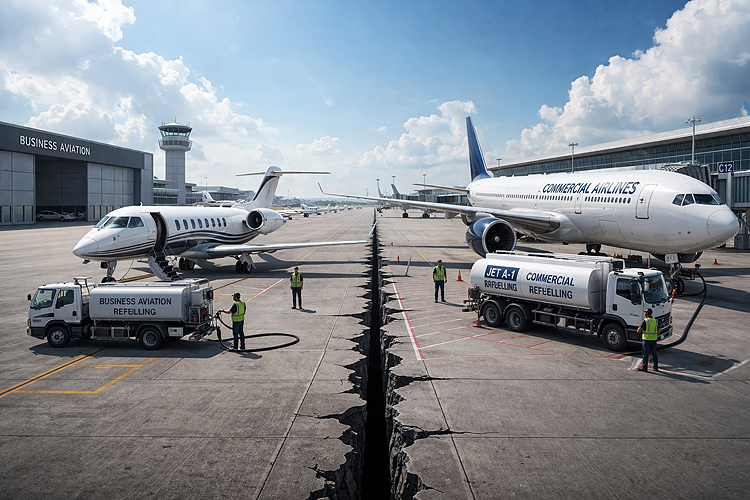
The recent revision in Aviation Turbine Fuel prices has been widely seen as a sharp escalation. Look closer and a different story emerges. The increase for scheduled domestic airlines is around 8 to 9 per cent. At the same time, business aviation and other non-scheduled segments, including even international operations, are facing much higher fuel benchmarks linked to global markets.
For the first time, fuel is not moving uniformly across the system. It is moving differently depending on who you are. That distinction matters.
For years, India's aviation sector has dealt with inefficiencies, but fuel pricing was at least consistent across users. Airlines, charter operators, corporate fleets, and air ambulance services all operated within the same framework
For years, India's aviation sector has dealt with inefficiencies, but fuel pricing was at least consistent across users. Airlines, charter operators, corporate fleets, and air ambulance services all operated within the same framework. That baseline has now shifted. One part of the system is being cushioned. Another is taking the full impact.
Within business aviation, the concern is not about high fuel prices. The sector is used to volatility. The concern is about parity. As an operator put it simply, "We are not asking for lower prices. We are asking for the same rules."
There is also a growing view that the current differential reflects a dated way of looking at the sector. Business aviation is still seen in some quarters as discretionary, rather than as an operational tool. That view no longer holds.
Business aviation today connects regions that scheduled airlines do not serve. It supports corporate movement across industrial clusters. It enables time-critical operations such as air ambulances, disaster response, and urgent logistics. It supports pilgrimage travel where connectivity is limited and is often used for organ transport and emergency missions.
There is also a growing view that the current differential reflects a dated way of looking at the sector. Business aviation is still seen in some quarters as discretionary, rather than as an operational tool
A simple data point adds context. The total fuel consumption of business aviation is a small fraction of that of commercial airlines. Its impact on overall fuel demand is minimal. Yet, it is the segment facing the sharper end of the current pricing structure. This raises a basic question. Is the pricing based on economics, or on perception?
In most global markets, fuel pricing does not distinguish between types of operators in this manner. In the United States, business aviation and airlines operate within the same fuel framework. In Europe, pricing remains transparent across users. In the Middle East, business aviation is actively supported as part of a larger connectivity and investment strategy. The common thread is simple. Not subsidy. Not protection. Just predictability and parity.
India now appears to be moving away from that approach. The Business Aircraft Operators Association (BAOA) has already flagged the issue in its submission to the Airports Economic Regulatory Authority (AERA). It points to "significant variability and uncertainty" in how charges are applied across airports. It also highlights the absence of a structured framework governing business aviation, even though these operators use the same infrastructure as scheduled carriers. The argument is straightforward. If the infrastructure is shared, the principles should be too.
What is happening now goes beyond fuel. It is about how costs are being distributed across the system. There is a clear case for supporting scheduled aviation. It carries scale and connects the country. But support cannot come without clarity on how costs are being shifted elsewhere. "If you start differentiating without rules, you create uncertainty. And uncertainty is worse than high cost", a senior industry player summed it up.
The question now is whether this is temporary or structural. If it continues, the implications go beyond fuel. The same logic can extend to navigation charges, parking, terminal access, and handling
That uncertainty is already showing up in planning decisions. Fleet deployment, basing, and long-term investments depend on stable assumptions. When those assumptions change without a clear framework, the impact goes beyond immediate costs.
The question now is whether this is temporary or structural. If it continues, the implications go beyond fuel. The same logic can extend to navigation charges, parking, terminal access, and handling. Over time, that creates a fragmented system.
Business aviation is not asking to be insulated from market forces. It operates in a competitive environment. What it needs is clarity on the rules. Parity is not about equal outcomes. It is about equal principles.
Business aviation isn't a luxury; it's a productivity tool and it deserves a fair policy
India's aviation market is growing fast. Airports are expanding. Fleets are increasing. Connectivity is improving. Business aviation is part of that ecosystem. It supports sectors that depend on speed and flexibility. It complements scheduled aviation.
Fuel prices will move. That is expected. But when pricing changes without principles, it is not the market that shifts. It is the trust!